
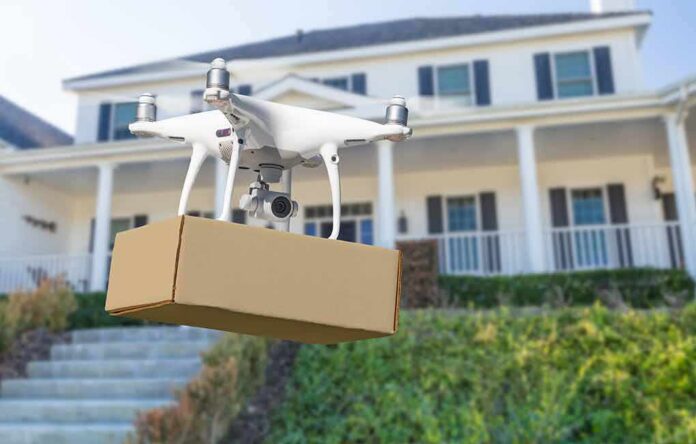
An 80-pound Amazon delivery drone tangled with neighborhood cables and landed on a Michigan garage after dropping shampoo.
Story Highlights
- Federal Aviation Administration opened an investigation after the Huntington Woods crash.
- Amazon confirmed the drone landed on a resident’s garage; no injuries were reported.
- Witnesses said the drone hit a thin fiber-optic cable during takeoff after a shampoo drop.
- Cellphone video reportedly shows the strike and rooftop landing on November 20.
FAA Confirms Probe After Residential Crash
The Federal Aviation Administration began investigating after an Amazon Prime Air drone struck a fiber line and contacted a garage in Huntington Woods on November 20. The preliminary report described cable contact, a structure strike, and entanglement during takeoff. CNBC identified the aircraft as the Amazon MK30 model operating north of Detroit. This was a residential neighborhood flight, not a test site. Officials described the report as preliminary, with no final cause issued yet.
Local outlets matched key details. Reports said the aircraft weighed more than 80 pounds and had completed a delivery moments before the mishap. Coverage noted Prime Air hubs tied to operations in Pontiac and Hazel Park. The sequence, as described by neighbors, placed the cable strike as the trigger for the failed departure. Those accounts align with the initial incident summary shared with reporters from the federal agency.
Amazon Confirms Landing On Garage, Cites No Injuries
Amazon spokesperson Jack Stelzner acknowledged the event and said a Prime Air drone “landed on a resident’s garage” during a delivery in Huntington Woods. The company said there were no injuries and that it contacted the homeowner. Amazon also said that “incidents are extremely rare,” but did not provide flight totals or a defined incident rate to compare risk across operations or aircraft models. The company stated that an internal review was underway.
Witness and customer statements provided added context about the package and path. WXYZ reported the drone delivered shampoo to customer Jim Brennan. During takeoff, the aircraft clipped a thin fiber-optic line, then ended up on neighbor Logan Coomes’s garage. That description tracks with local video reports that show a cable strike followed by a rooftop landing. Outlets that viewed or sourced the clip described the aircraft contacting a line, then a structure.
What We Know About The Aircraft And The Route
CNBC identified the drone as Amazon’s MK30, the company’s newer delivery model aimed at suburban routes. Local reporting placed the mishap in a typical low-altitude environment crowded with cables and trees. Academic reviews have long flagged takeoff and landing as the riskiest parts of drone delivery due to dense obstacles and changing ground features, unlike controlled airport zones. These hazards demand precise mapping, reliable sensors, and conservative routes to avoid thin, hard-to-see lines.
Reports varied slightly on whether the drone also struck a tree or shed parts before the rooftop landing, but all agreed it contacted overhead lines and a garage. Those variations are common in early accounts and do not change the core event: cable strike, structure contact, and no injuries. The Federal Aviation Administration will determine the final sequence and any compliance issues. That process can include data logs, site photos, and operator records.
Why This Matters For Neighborhood Safety
Huntington Woods is not a test range. Families live under these routes. When an 80-pound aircraft meets a cable above a driveway, the stakes are clear. Research on drone delivery risks points to obstacles, component failures, and communications gaps as persistent challenges. Streets full of utility lines make precision vital, especially when flights rise from or descend into tight spaces near homes, cars, and kids at play. Prudent safeguards must match real-world neighborhoods, not lab conditions.
🤣 🇺🇸 🧠 Amazon Drone SI Delivers Shampoo Then Crashes Into Neighbor’s Garage Roof After Snagging Wire
An 83-pound Amazon Prime Air MK30 completed a suburban shampoo drop in Huntington Woods, Michigan, only to strike a fiber-optic cable on climb-out, lose a propeller, tangle in…
— Joe (@LTSmash420) November 24, 2026
Under President Trump, federal agencies are expected to protect public safety while allowing innovation that serves customers. That balance starts with strict enforcement when flights threaten people or property. The Federal Aviation Administration can issue warnings, corrections, or civil penalties when operators endanger the airspace or ground areas. Transparent findings, clear incident metrics, and route designs that account for every cable and pole are basic steps before scaling more flights over front yards.
Sources:
mynbc5.com, arstechnica.com, kake.com, clickondetroit.com, gmg-wdiv-prod.cdn.arcpublishing.com, aip.vse.cz