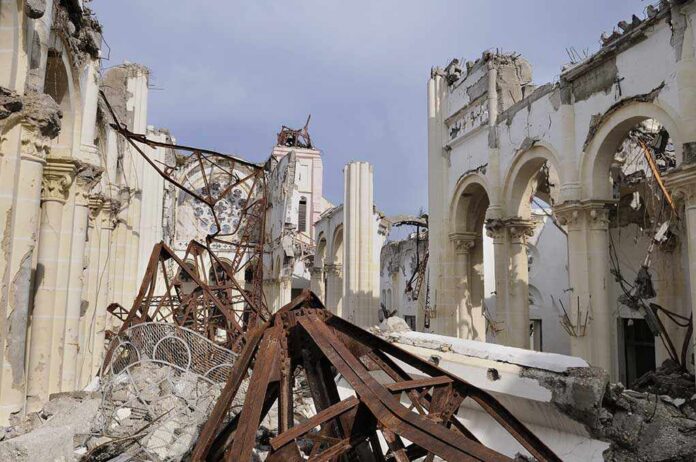
A Russian drone blast shattered a historic Catholic cathedral in central Odesa, injuring civilians across the city and jolting a community at prayer.
Story Snapshot
- A Shahed-type drone exploded just outside Odesa’s Roman Catholic cathedral, breaking doors and windows.
- The parish priest said staff and clergy survived without injuries, calling it a near-miracle.
- Officials reported three city strikes that killed four and injured between about ten and 13 people.
- Nearby shops, cars, and a restaurant between the cathedral and curia also suffered damage.
Blast Damage At A House Of Worship
Witness accounts placed the explosion steps from the Roman Catholic Cathedral of the Assumption of the Blessed Virgin Mary in central Odesa late morning on November 18. Parish priest Myroslav Karachyna said a Shahed drone fell and exploded right in front of the cathedral. The blast damaged almost half the windows, the metal front door, and the vestibule door. Windows in the adjacent diocesan curia broke on all three floors. Cathedral and curia staff were unharmed, he said.
Reports from church and local outlets described damage beyond the church grounds. Shattered glass and debris hit nearby shops and bars. Parked cars were dented and scraped. A restaurant located between the cathedral and diocesan offices was damaged as well. Residents photographed blown-out storefronts and twisted metal grilles. The scene underscored how a single blast can ripple through a busy city block, striking faith, family businesses, and daily life at once.
Citywide Strikes And Civilian Toll
Regional authorities said Russian forces struck Odesa three times that day. Governor Oleg Kiper reported four people killed and 13 injured across the city. Some church reports cited about ten injured. The difference likely reflects reporting cutoffs and updates during the response. All outlets agree the death toll reached four and that injuries climbed into double digits. None of the cited reports linked deaths directly to the cathedral site itself.
These strikes fit a larger pattern in the war. United Nations monitors have reported sharp rises in civilian casualties tied to long-range weapons, including drones. Their recent updates state that drones and missiles remain leading causes of civilian harm in Ukraine. That backdrop helps explain why damage to homes, shops, and churches continues, even far from the front lines. It also shows why communities brace for more attacks as winter nears.
What The Priest Saw And Why It Matters
Father Karachyna gave a clear, timely account from inside the blast zone. He described the drone’s approach, the point of detonation, and the direct effects on doors and windows. His statement anchors what happened at the cathedral with named, on-site testimony. Other witnesses believed the drone may have been falling after air defense action, but available reports do not resolve that sequence. What is not in dispute is the blast site and the resulting damage to the church and curia.
UKRAINE
A Russian drone exploded this morning right in front of the Catholic Cathedral of the Assumption of the Blessed Virgin Mary in central Odesa, damaging the church and the adjacent diocesan curia. Local authorities report four dead and about ten injured in three attacks on… pic.twitter.com/rEsZZk9vu5
— Vatican Report (@VaticanReportIt) November 18, 2026
For many readers, an attack that scars a church cuts deeper than broken glass. Houses of worship are pillars for families and tradition. They are where we pray, marry, baptize our children, and mourn our dead. When a drone explodes at the cathedral steps, it is not just stone and stained glass at risk. It is culture, faith, and community life. That is why this incident resonates far beyond Odesa and reminds us to stand firm for religious freedom and human dignity.
Sources:
agensir.it, vaticanreport.com, infovaticana.com, zenit.org, ground.news