
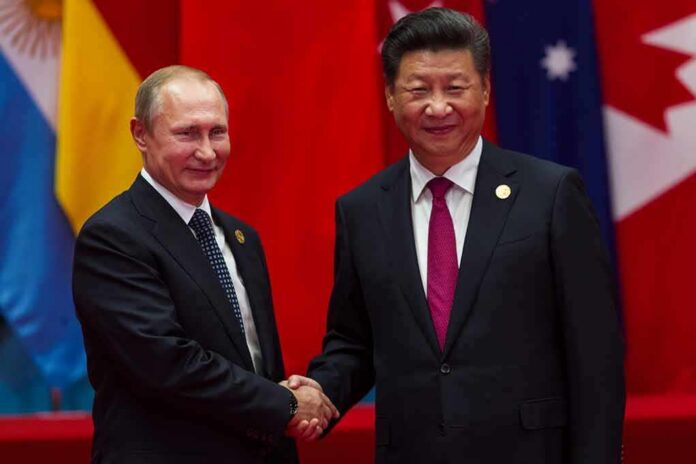
President Trump stood alongside China’s Xi Jinping and Russia’s Vladimir Putin in Shenzhen as APEC opened, signaling hard-nosed diplomacy on a global stage backed by American strength.
Story Highlights
- APEC leaders gathered in Shenzhen for welcome events on November 18 and plenary meetings on November 19.
- Trump, Xi, and Putin exchanged greetings before the welcome banquet and joined the group photo.
- China, as host, set the images and pacing of official coverage under APEC rules.
- Photos stirred debate, but protocol required leader “family photos” at set moments.
Leaders Converge in Shenzhen Under Host-Controlled Protocol
Chinese government accounts confirm that the 33rd Asia-Pacific Economic Cooperation leaders’ meeting gathered in Shenzhen, with a welcome banquet and formal group photographs on November 18. China’s president hosted leaders, representatives, and spouses at the Shenzhen International Communication Center, marking the summit’s ceremonial kickoff. APEC guidelines place the host in charge of official photographers and broadcast materials. That means China shaped the immediate optics and flow of public images throughout the summit.
Major outlets reported President Trump’s arrival and participation, noting the high-profile interactions at the welcome events. Reports described Trump, Xi, and Putin greeting each other before the family photo and then proceeding to the banquet, where leaders mixed under tight protocol. The next day, November 19, brought the leaders’ plenary meeting and another set of official images, including Trump and Xi in the formal proceedings, as the summit moved from ceremony to policy.
Trump, Xi, and Putin Share the Frame as Business Begins
Media coverage documented the rare moment of Trump, Xi, and Putin before the family photo, a diplomatic scene that drew intense attention and strong reactions. Outlets placed the greeting and photo gathering on November 18 during the host’s welcome sequence. Coverage then showed Trump and Xi at the November 19 plenary, where leaders advanced the formal agenda. The exact remarks from the plenary were not published in the cited material, but attendance and sequencing are well established.
The timeline matters. The welcome photo on November 18 followed established protocol. The plenary on November 19 focused on the summit’s economic work. Keeping the days straight avoids confusion over what each image represents. The November 18 photos capture ceremony and positioning, while the November 19 images reflect the start of policy talks and leader statements inside the formal session.
What The Optics Mean—and What They Do Not
The APEC “family photo” is a routine feature of multilateral meetings. It shows who attended. It does not equal policy alignment. The host economy decides the timing, setting, and distribution of official images under APEC rules, which is why China’s visuals reached the world first and shaped public reaction. Leaders often face criticism for standing near rivals in these photos. That debate is about optics, not evidence of changing policy or values.
Watch | Shenzhen, China: US President Donald Trump addresses the 33rd APEC Economic Leaders' Summit.
During this, he says, "And here in China, I look forward to a historic trilateral meeting with President Xi and President Putin later today to discuss more opportunities for all… pic.twitter.com/9FOcWsx0Vc
— United News of India (@uniindianews) November 19, 2026
For American readers, the key is results. President Trump used the Shenzhen stage to press U.S. interests at a forum centered on trade, supply chains, and growth. Standing on the same riser as rivals showed resolve, not retreat. The summit structure placed America’s president in the room where economic rules are discussed and set. That is where the United States must lead to defend secure borders, fair trade, energy independence, and family budgets from global shocks.
Sources:
edition.cnn.com, abcnews.com, news.abs-cbn.com, yahoo.com, cnbc.com, asean.china-mission.gov.cn, charlotteobserver.com