

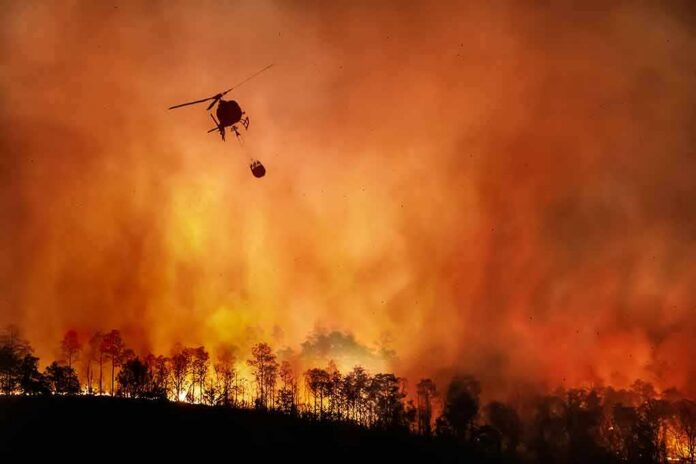
Satellite images show Amazon fires exploding across Brazil this fall, and NASA scientists say a natural weather cycle called El Niño — not man-made climate policy — is the driving force behind the smoke choking an entire city.
Story Snapshot
- NASA satellites recorded a sharp jump in Amazon fire activity starting in September 2026.
- Brazil’s Amazonas state logged nearly four times more fire hotspots than a year earlier.
- NASA scientists tied the surge to an El Niño-driven drought, with human land-clearing fires spreading into dry forest.
- Heavy smoke shut down schools in Manaus, a city of over two million people.
- Officials expect more fire waves through December and January until seasonal rains return.
Satellites Show Fires Exploding Across the Amazon
NASA’s Earth Observatory reported that satellites picked up a sharp rise in fire activity and smoke across the central and eastern Amazon starting in September 2026. The agency’s MODIS instrument captured images on October 12 showing heavy smoke pouring from fires on both sides of the Amazon River. Brazil’s own space research institute backed up the trend, recording more than 3,700 fire hotspots in Amazonas during September alone, nearly four times the total from the year before.
The numbers kept climbing into October. One report found 1,679 fires in Amazonas during just the first two weeks of the month, a 253 percent jump over the same stretch in 2025. NASA scientist Shane Coffield estimated 50 to 70 uncontrolled fires were burning near Santarém alone, a staggering figure for a single region in a rainforest that normally holds too much moisture to burn easily.
Drought Driven by El Niño, Not Just “Climate Change”
NASA’s Douglas Morton, an Earth system scientist at Goddard Space Flight Center, described the burning around Santarém and Manaus as part of a “cascade” of tropical fires tied directly to El Niño’s disrupted rainfall patterns. That’s a key distinction many outlets gloss over when they lump every wildfire into the broader “climate change” bucket. El Niño is a well-documented, naturally occurring ocean-warming cycle that has driven severe Amazon fire seasons before, including in 1992-93 and 1997-98, long before “climate crisis” became a political slogan.
The drought numbers back up NASA’s explanation. Brazil’s national weather institute reported Manaus received just 44 millimeters of rain from July through September 2026, compared with a normal 202 millimeters. That kind of rainfall collapse dries out vegetation and primes it to burn, regardless of what label activists or politicians want to slap on the cause.
Smoke Chokes Manaus, Schools Shut Down
The human cost is already showing up in daily life. Heavy smoke from the surrounding fires blanketed Manaus, Amazonas state’s largest city and home to more than two million people, forcing school closures as air quality worsened. Brazilian authorities declared fire emergencies in 36 towns across Amazonas as the dry conditions spread. These are real disruptions to real families, not abstract satellite data points on a government website.
Human-Set Fires on Cleared Land Fuel the Spread
A researcher cited in Amazon fire reporting noted that most fires start on pasture or already cleared land, then escape into forest when conditions turn dry. That detail matters. It means a good share of this crisis traces back to land-clearing practices for farming and ranching, not some abstract industrial emissions narrative pushed by global climate bureaucrats. El Niño sets the stage by drying out the forest, but people are still the ones striking the match.
More Fire Waves Expected Before Rains Return
NASA expects additional fire activity through November and December in Roraima, northern Pará, and Amapá, along with parts of Venezuela, Guyana, and Suriname. Scientists say the current fires are likely to keep burning until seasonal rains arrive in December 2026 or January 2027. The season is still young, so final totals for 2026 aren’t locked in yet, but the early trend already points toward a long and difficult burning period for the region.
What’s clear from NASA’s own data is that a natural climate cycle, combined with longstanding land-use practices, is behind this year’s fires — not some new man-made catastrophe requiring sweeping global policy overhauls. Conservatives watching from the United States should take note of how quickly some outlets reach for the “climate change” framing before the natural explanation, El Niño, even gets a fair hearing.
Sources:
science.nasa.gov, latintimes.com