
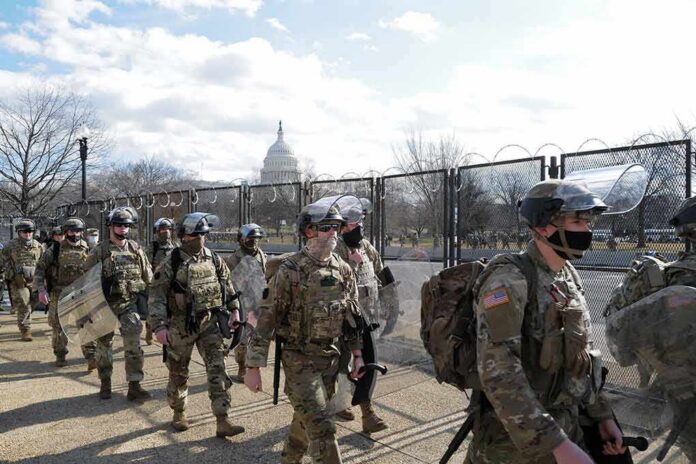
A federal judge found parts of Washington’s long-running National Guard mission unlawful, yet the deployment continues for years and at great cost.
Story Highlights
- A federal court said the D.C. Guard deployment was unlawful without local consent, though the ruling is on hold for appeal.
- The Pentagon extended the mission through January 2029, with nearly 9,700 troops rotating since 2025 and an estimated $1.4 billion price tag.
- Guard leaders said the mission lasts until Inauguration Day 2029 or “until the president says the mission is over”.
- Officials credit the operation with big arrest numbers and crime drops, while critics warn of militarized policing near voting sites.
Judge Flags Legal Limits While Appeal Keeps Troops on Streets
A federal court ruled that the District of Columbia National Guard deployment was unlawful without a request from the city, and the judge issued a preliminary injunction. The court then stayed that order to allow an appeal, keeping the mission in place during litigation. An appeals panel later allowed the deployment to continue while the case proceeds, citing the unique federal status of the District and the president’s asserted power there. The legal fight stays active as the mission rolls on.
The case turns on who controls law enforcement in the nation’s capital. The District’s elected leaders argue they were sidelined from ordinary policing decisions. The administration argues it is tackling a declared public safety crisis. That unresolved clash matters for constitutional balance and for every American who wants crime down without giving Washington a blank check. The court’s pause means residents live with the policy first and get answers later.
Scale, Duration, and Cost Show an Unusual Domestic Mission
The mission’s size and length set it apart. Reporting tallied nearly 9,700 Guard members rotating through Washington since August 2025. The Pentagon extended the deployment through January 2029, and planning documents pegged projected costs near $1.4 billion. Those figures reflect an operation far beyond a short emergency surge. Long rotations, travel, housing, and support drive costs. For taxpayers dealing with inflation and high bills, that price tag raises hard questions about value and oversight.
Guard leadership described an open-ended end date tied to Inauguration Day or the president’s decision. Brigadier General Leland Blanchard II said the Guard would remain through the next inauguration or “until the president says the mission is over.” That puts a military footprint on city streets for multiple years unless reversed sooner. Federal descriptions say troops focus on presence patrols to deter crime, while letting police shift resources elsewhere. That aims at visible safety but also normalizes uniforms in daily civic life.
Supporters Cite Crime Drops; Critics Warn of Overreach Near Ballot Sites
Federal officials link the deployment to crime declines and large arrest totals. The White House and partner agencies touted tens of thousands of arrests and reported drops in total crime, car theft, and homicides over the period. President Trump publicly credited the mission for making the city safer. A public analysis found petty property crime fell with the Guard in place but did not show a measurable effect on violent crime, a mixed result that invites more data review.
Civil-liberties groups and local critics warn the mission blurs lines between military and police. They object to Guard patrols near ballot drop boxes and voting locations, saying that can chill civic participation. Officials said they sought limits on troop placement around voting sites, reflecting that concern. Anonymous Guard members also voiced unease about the mission’s effect on the institution’s reputation, though such accounts are hard to verify independently. These warnings call for clear rules, transparency, and strict respect for constitutional rights.
Conservative Takeaway: Safety Matters, But So Do Guardrails
Conservatives want safe streets, respect for police, and accountability for violent criminals. They also want limited government and faithful obedience to the Constitution. The ongoing lawsuit signals that even a well-meant anti-crime push must fit within the law. Congress and the courts must set bright lines on how and when the National Guard supports local policing, especially in the unique setting of the District of Columbia. Lasting security requires both order and liberty.
What to watch next: the appeals court’s ruling on core authority; updated crime data tied to clear methods; detailed deployment maps restricting activity near voting sites; and a public accounting of costs and contracts. If the mission continues, strict transparency, narrow tasks, and firm timelines can protect rights while backing law enforcement. If courts rein it in, Washington should shift to local control with federal help that respects our constitutional boundaries, not erodes them.
Sources:
ground.news, npr.org, commondreams.org, galvnews.com, theintelligencer.net, acludc.org, thehill.com, theatlantic.com, newsweek.com, usmcu.edu