

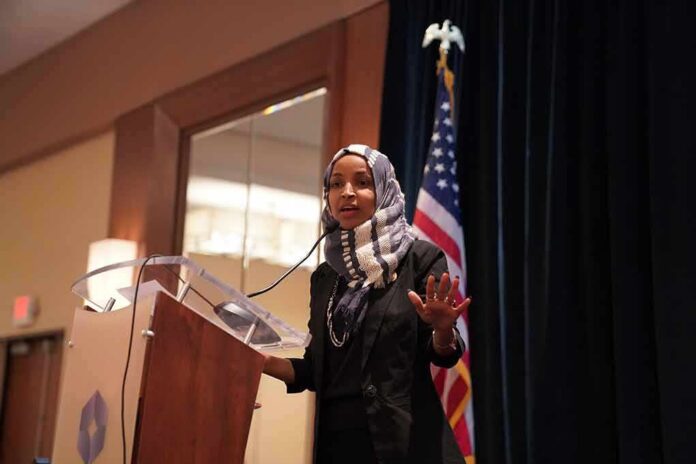
A federal grand jury questioned Rep. Ilhan Omar’s former bodyguard about her immigration and marriage history as agents searched her home, signaling a serious criminal probe with real stakes for public trust.
Story Snapshot
- A grand jury pressed a key Omar insider about her 2009 marriage and a $10,000 payment.
- Prosecutors charged the insider, then moved to dismiss the case the day after his testimony.
- Federal agents searched Omar’s Washington, D.C., residence amid subpoenas and witness questioning.
- Omar denies wrongdoing; no public indictment of her has been announced.
What Investigators Did And Why It Matters
Public records and reporting show federal prosecutors used a grand jury to test claims tied to Rep. Ilhan Omar’s immigration and marriage history. On September 3, 2026, former bodyguard Abdullahi Mohamud Mohamed testified and faced questions about Omar’s 2009 marriage, family immigration, and a $10,000 payment. Federal agents also searched Omar’s Washington residence and issued subpoenas. These steps indicate an active criminal inquiry, not only political talk, even as many materials remain sealed and grand-jury testimony is secret by law.
Prosecutors had earlier charged Mohamed with a felony for alleged false statements during a green-card interview, including questions tied to contacts and work linked to Omar. The timeline is striking: indictment in April, grand-jury testimony on September 3, and a government motion to dismiss on September 4, which the court granted days later. The official reason for dismissal cited his anticipated removal from the United States, not a public claim that he delivered incriminating evidence.
The Disputed $10,000 Payment And What Is Proven
Reports describe a $10,000 payment that investigators and commentators flagged as suspicious, while an alternative explanation involved debt repayment. The available materials do not establish the purpose of that payment with bank records or messages, and do not prove a bribe or any specific agreement. Likewise, coverage highlights a search of Omar’s home and subpoenas to associates, but a search warrant and grand-jury process show investigative steps, not final proof of a crime by Omar.
Key weaknesses temper sweeping claims. The court dismissed Mohamed’s charge without prejudice and provided no transcript of his testimony. The public record does not show that he implicated Omar or that prosecutors confirmed such claims. The government’s dismissal pointed to immigration removal, which undercuts using the dismissal as proof of cooperation or a cover-up. Importantly, no charge against Omar has been announced in public filings to date.
Where Comer’s Prediction Stands, And What Comes Next
House Oversight Chairman James Comer has predicted an indictment of Omar, saying “They’ve got her.” The known record supports that prosecutors treated the matter seriously, with a grand jury, subpoenas, a residential search, and a pressured insider witness. It does not, however, show a returned indictment of Omar at this time. Omar denies wrongdoing and calls the probe political. She says she did not commit immigration fraud and rejects claims about her 2009 marriage.
For readers who value equal justice, several next steps matter. First, unsealed filings in United States v. Mohamed could clarify what prosecutors pursued and why dismissal was sought. Second, any unsealed search-warrant affidavit would show the evidence used to justify the home search. Third, bank and communications records could confirm or refute competing stories about the $10,000 transfer. Until then, the facts show an aggressive federal probe, a charged and dismissed insider case, and no public charge against Omar.
Sources:
pjmedia.com, nytimes.com, washingtonexaminer.com, yahoo.com, nacdl.org, commondreams.org, apnews.com, congress.gov