

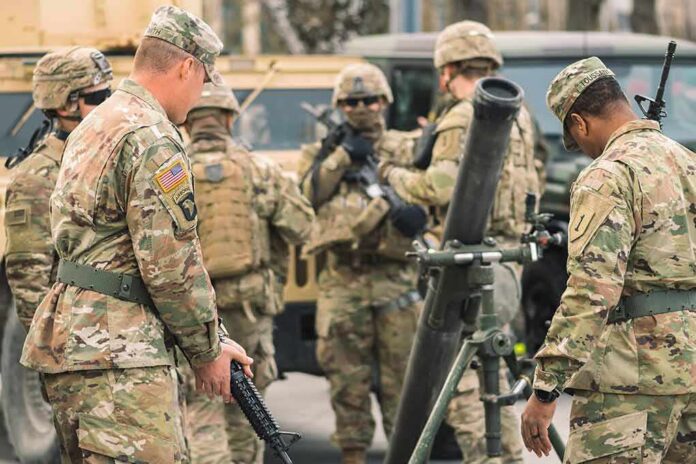
Washington is quietly weighing U.S. training for Syria’s new army even as investigators link government-affiliated units to massacres of Alawites, Christians, and Druze.
Story Snapshot
- Proposal would start with mine-clearance training for Syrian troops, not combat operations.
- Reports tie transitional-era Syrian forces to sectarian killings and failed accountability.
- President Trump has argued Syria should confront Hezbollah to reduce regional costs.
- Any U.S. training must pass Leahy human-rights vetting before it can proceed.
What The Proposal Actually Seeks To Do
Reuters-based reports say U.S. officials are discussing a narrow plan to train Syrian military personnel in mine clearance. The plan would mark the first U.S. training effort with Syria’s armed forces since the 2024 transfer of power in Damascus. The reports do not describe a combat partnership or a green light for Syrian-led operations against Hezbollah. The initial mission is technical and limited, focused on removing explosives and improving basic security functions.
Supporters of the concept say even a small training channel can shape behavior. A direct link could help set standards, improve border security, and build habits that protect civilians. Advocates also note that mine removal reduces deaths and speeds rebuilding, which stabilizes communities and discourages extremist recruitment. The United States has used such targeted training in other conflicts to reduce risks while gaining leverage over a new security force’s structure and conduct.
Why Rights Concerns Tower Over The Debate
Human-rights records from 2025 and 2026 paint a harsh picture. A United Nations-backed inquiry, reported by the Associated Press, detailed widespread violence against Alawite civilians in Syria’s coastal region and flagged units tied to the new army in alleged abuses. The United States Commission on International Religious Freedom said transitional authorities failed to stop or punish mass killings that struck Alawites, Druze, and Christians, and cited roles by security forces and key ministries. Survivors still await justice.
The United States cannot lawfully train foreign units that have credible links to gross human-rights violations. The “Leahy Laws” require vetting of every unit and individual before assistance, with aid blocked when credible information shows serious abuses. The State Department and the Department of Defense must screen names, review records, and deny support to any tainted force. That bar is high and should be. It protects U.S. values, prevents complicity, and guards taxpayer money.
Trump’s Strategic Aim And The Hezbollah Question
President Trump has pressed regional actors to shoulder more of the burden against Hezbollah. He has argued that Syria should take the lead and suggested it could do the job faster, which would lower the human and political costs of a long war. The reported training idea fits that broader push by opening a channel to the Syrian military. Yet the public record does not show an approved combat role for Syria or proof that Syria can or will defeat Hezbollah. The evidence supports only a demining start.
Conservatives expect results without mission creep. Any move must be narrow, measurable, and reversible. Clear guardrails can protect U.S. interests: publish unit rosters for vetting, name the metrics for mine clearance, and suspend assistance at the first sign of abuse or diversion. If Syrian leaders want legitimacy, they should back trials for implicated commanders, open records to inspectors, and protect minority communities. No justice, no training. That is common sense and the law.
Congressional Oversight And The Red Lines That Matter
Congress should demand the interagency plan, including objectives, timelines, and a stop-loss clause. Lawmakers can require quarterly reports on vetting decisions, trainee performance, incidents against civilians, and any contact with armed groups. They should also press for written commitments from Damascus that bar units with abusive histories and mandate cooperation with independent investigators. If the executive branch cannot certify compliance, Congress must halt or defund the program immediately.
Americans have seen vague “limited” missions turn into open-ended entanglements. A tight focus on demining can save lives and help families go home. But training must never whitewash sectarian crimes or reward bad actors. The path forward is strict: prove clean hands, follow the metrics, and deliver security for every community, including Alawites, Christians, and Druze. Anything less betrays U.S. values, breaks the law, and risks dragging our troops and dollars into another failing experiment.
Sources:
zerohedge.com, efile.fara.gov, the-independent.com, kurdistan24.net, uscirf.gov, timesofisrael.com