

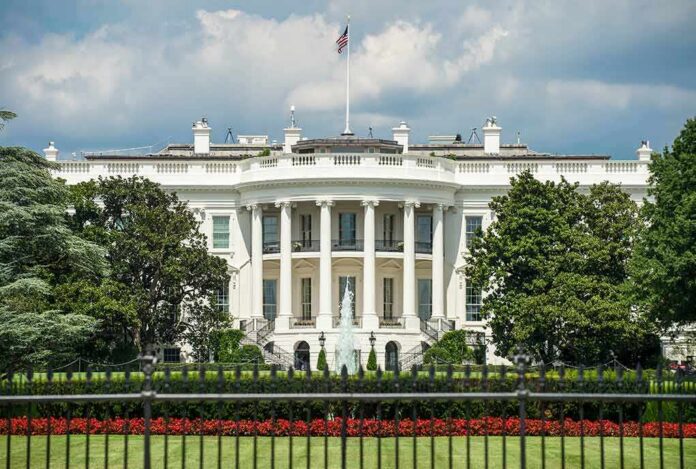
President Trump says the new White House ballroom will cost taxpayers nothing, even as critics push claims of hidden public spending and legal roadblocks.
Story Highlights
- Trump says private donors are covering the ballroom, not taxpayers.
- White House filings say hundreds of millions in private donations are pledged.
- Construction continues after a Supreme Court stay, with work described as ahead of schedule.
- Opponents cite reports of rising costs and unresolved legality questions.
Trump’s Funding Pledge And The Paper Trail
On August 22, President Trump said the ballroom “will be paid for with ZERO Dollars of Taxpayer Money,” crediting “Great American Patriots and Companies” for the full tab. A White House management declaration backs the private-funding model, stating that donors have pledged $335 million toward an expected $400 million total. These numbers anchor the administration’s message: this is a patriotic gift, not a government boondoggle. That framing matters to taxpayers who have watched Washington spend beyond its means for years.
Supporters view the donation plan as common sense. Private dollars ease pressure on federal budgets bloated by years of overspending. They also align with limited-government ideals conservatives champion. Trump has also pitched the ballroom as a lasting gift to the nation, not a vanity project, saying it comes “at no cost to the American Taxpayer”. That message resonates with readers tired of Washington’s habit of throwing public money at every problem.
Progress On Site: Work, Schedule, And What We Know
On September 23, Trump told reporters the “entire left portion, the north portion has been built structurally,” and said the project is “very much ahead of schedule,” noting the first column set that day. Reporting states the administration described the work as about sixty-five percent complete, and that construction quickened during the appeals fight. For readers, the takeaway is simple: crews are building, milestones are ticking, and the project continues while lawsuits play out.
That momentum reflects a key legal turn. The Supreme Court allowed work to continue while the case proceeds, a significant interim victory for the administration’s approach. A stay is not a final ruling on the merits, but it cleared a major roadblock. After years where courts often froze conservative priorities, many see this as a welcome change: let work continue while lawyers argue. That balance respects the presidency’s operational needs without pre-judging the outcome.
Competing Claims: Cost, Law, And Transparency
Critics dispute the “all-private” funding line. Some reports cite contractor records and agency budgets that suggest a larger, $600 million scope with public security upgrades folded in, implying taxpayers could cover a share. Others argue the price tag moved from $200 million to $400 million and then higher, undercutting “under budget” claims. These disputes deserve clarity. The cleanest fix is sunlight: publish donor lists, amounts, and transfers, and release the contractor’s schedule and change orders.
Legal questions also hang over the project. Commentary stresses that private donations do not automatically replace congressional authorization where federal property and appropriations are involved. The Supreme Court’s action so far focused on procedure and standing, not the final legality of using private funds for a project of this scale. That means the case can still test where executive authority ends and Congress’s power of the purse begins. Conservatives can back both goals: protect taxpayers and respect the Constitution’s checks and balances.
What Conservatives Should Watch Next
First, demand full transparency on money flows. If the ballroom is truly a private gift, full donor disclosure and ledger records will prove it. White House management already cites hundreds of millions raised; public accounting would settle doubts and deflate media spin. Second, ask for the baseline schedule and monthly reports. If the project is ahead of schedule, show the critical-path data so critics cannot paint progress as bluster. Proof beats punditry.
White House press ban still in force (as of Sept. 23).
CNN, POLITICO, and MS NOW remain locked out. Judge Timothy Kelly heard the First Amendment case Wednesday, questioned due process, and left the ban in place pending a ruling “as soon as possible.”
DOJ: access is a “privilege,…— Roger (@Bayliner4588) September 24, 2026
Third, seek a clear legal roadmap. A formal opinion explaining how private donations interface with statutory limits would help end the “gotcha” game and ensure the project honors both tradition and law. That protects the presidency from future activist lawsuits and sets a fair standard for any administration. Finally, keep perspective. Presidents before Trump accepted private help for improvements. If this ballroom can be funded by donors and fortified by lawful process, taxpayers win and the People’s House gains a venue fit for state duty.
Sources:
townhall.com, krgv.com, dailysignal.com, thehill.com, cbsnews.com, abcnews.com