

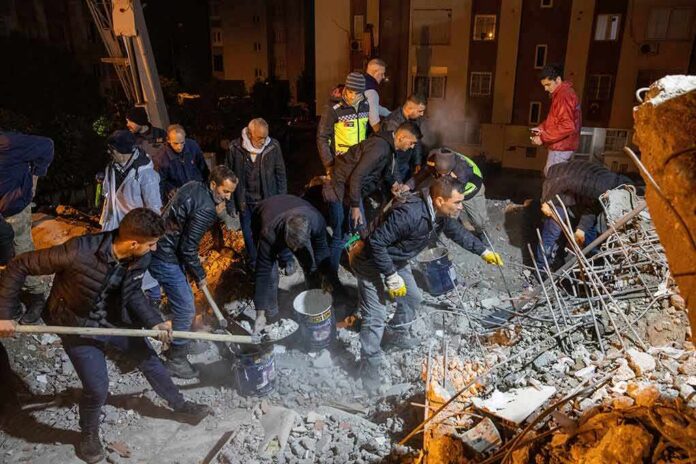
Eight people were killed after a three-story Brooklyn building collapsed beside an active construction site, and city records now show a trail of safety violations tied to that work.
Story Highlights
- Officials focused on nearby excavation and construction as investigators examine the cause.
- Records show prior violations at the neighboring site, including unsafe demolition and stop-work issues.
- A pre-construction survey flagged cracks on the collapsed building’s north side months earlier.
- Firefighters ran a risky, round-the-clock search amid fears of a secondary collapse.
Rescuers Worked In Dangerous Conditions To Find Victims
Firefighters and rescue teams pulled survivors and victims from a deep pile of brick, wood, and metal after the collapse at 1321 Flatbush Avenue. Crews used excavators, chainsaws, and hand tools to cut through unstable debris. Search dogs and vacuum trucks helped clear out tight spaces that people could not reach. Commanders warned about a possible second collapse as they moved piece by piece. Officials said the operation would continue until every area was searched and accounted for.
Officials said an adjacent structure became so unstable during the response that crews partially took it down to protect rescuers and neighbors. The choice slowed the search but reduced risk to those on scene. The Fire Department coordinated with city agencies to close streets, move heavy equipment, and check for gas and power hazards. Emergency workers reported steady progress even as shifting debris and rain complicated the work. The death toll reached eight as searches advanced and more voids were cleared.
Investigators Zero In On Excavation And Permit History
The New York City Department of Buildings issued a full stop-work order for the neighboring construction site as investigators examined the cause. The site held an active excavation and foundation permit at the time. The department said the construction and digging next door were a primary focus of the probe, along with the sequence of work that led up to the collapse. Inspectors documented site conditions, measured wall and soil movement, and reviewed whether required supports were in place.
Public records reported by industry outlets show the neighboring project had earlier violations. City inspectors cited the contractor for beginning demolition without required overhead protection for the adjacent building, a condition that “creates hazards to people and properties.” Later, officials said work continued even after a stop-work order, leading to further penalties. Administrative law judges issued fines that totaled thousands of dollars. Those actions now frame a central question: did permitted work follow the safety plan, and was it enforced?
Pre-Existing Cracks Complicate The Causation Picture
A pre-construction survey filed months before the collapse documented cracks on the collapsed building’s north facade, which faced the construction site. The report described that side as in poor condition, with noticeable cracking that needed close watch. That finding gives investigators two tracks to test. First, whether those pre-existing flaws signaled a weak wall or foundation. Second, whether excavation or demolition next door changed soil or support enough to push a marginal structure past failure.
Reporters have also noted a broader pattern in city construction failures. Disputes often center on a mix of aging buildings and aggressive digging at nearby sites. A 2019 Department of Investigation case described contractors who kept excavating while a wall moved and a neighbor reported a cave-in, warning that such practices pose immediate danger to life and property. Investigators on the Flatbush collapse are following a similar logic: examine the building’s health and the neighbor’s work, then match evidence to each step.
Records, Accountability, And The Path Forward
City officials will review permits, engineering plans, and daily logs to confirm if contractors installed the right shoring, sheeting, and monitoring before excavation. They will compare approved drawings to field conditions and interview workers and managers. They will also look at whether enforcement moved fast enough when hazards were found. If the stop-work order was ignored, the record will show when and by whom, and whether penalties were strong enough to change behavior.
Brooklyn building collapse at 1321 Flatbush Avenue — what the traced record shows
– At least eight people were killed and 18 injured when the three-story building at 1321 Flatbush Avenue collapsed on November 11, 2026 and largely fell into the construction site adjoining it,… pic.twitter.com/fabDzZit6v
— TrustInsightReport (@trustinstrpt) November 13, 2026
Families of the victims deserve clear answers about what failed, who failed, and why safeguards did not hold. For many readers, this raises core conservative concerns: government must enforce basic safety rules, not drown builders in red tape while missing real risks. Strong, even-handed oversight protects life, property, and small businesses. When agencies issue stop-work orders, they must ensure compliance. When contractors take shortcuts, penalties must be swift, public, and serious.
Sources:
nydailynews.com, abc7ny.com, newyork.news12.com, bisnow.com, newsweek.com