
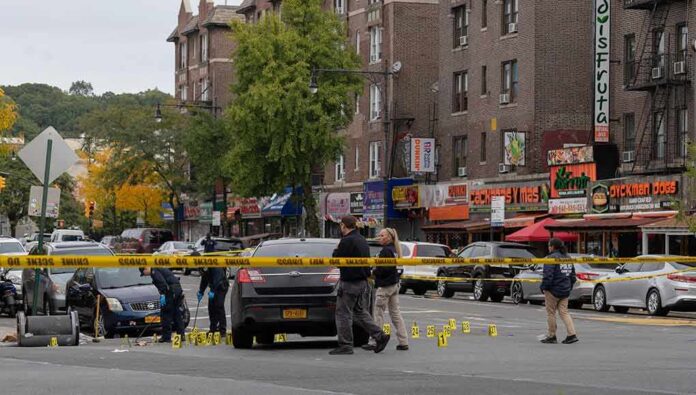
A man with a prior arrest and a missed court date was shot dead by an off-duty FBI agent after reports he was firing toward a Chicago homeless camp, raising urgent questions about release policies and basic public safety.
Story Highlights
- Officials say the man was seen firing toward a homeless encampment before an off-duty FBI agent shot him.
- Court and police records show a prior retail-theft arrest and a missed court date that led to a warrant.
- The FBI says its Inspection Division is reviewing the shooting under standard policy.
- Claims about immigration custody or “catch and release” remain unverified in public records.
What officials confirm about the Pilsen shooting
The Federal Bureau of Investigation (FBI) said an agent-involved shooting took place near West 18th Street and South Union Avenue on October 26, 2026, and that its Inspection Division is reviewing the incident under FBI policy. Local reporting identified the deceased as 27-year-old Oscar D. Isaya-Corrales. ABC7 and FOX 32, citing officials and federal sources, reported that the off-duty agent encountered Corrales while commuting and that Corrales was firing into a homeless encampment before the agent shot him.
A Chicago police account reported that responding officers found an FBI agent with a gun trained on Corrales after the shooting, which matched an unnamed witness who saw an officer behind an unmarked vehicle with a weapon drawn. A Chicago alderman said witnesses described two bursts of gunfire minutes apart, suggesting an earlier volley before the vehicle linked to the agent arrived; he called for a full investigation to clarify the sequence and facts. Authorities have not released body-camera videos or ballistic findings at this time.
The prior arrest, missed court date, and open warrant
Chicago arrest records show police arrested Corrales on May 25, 2026, after a reported attempt to steal five necklaces worth about $320 from a Nordstrom store. The arrest report also stated he had a Guatemalan passport that did not appear to belong to him, though officers could not confirm if it was stolen at that time. Court records list a failure to appear for a scheduled hearing and a judge issuing a warrant on June 1, meaning he was not in custody when the October shooting occurred.
These records speak to local criminal-justice handling, not federal immigration custody. The reports establish a timeline of a nonviolent retail theft arrest, a missed court date, and a warrant, which are common markers in urban courts. They do not, by themselves, explain why no detainer, hold, or other action kept Corrales in jail. They also do not show that a different choice would have stopped the later gunfire. That connection is a policy argument, not a proven fact from these documents.
Immigration-status claims remain unproven in public files
Some outlets framed Corrales as a Venezuelan immigrant who was “caught and released under Biden,” but the available public record does not show an immigration file, a unique case number, a federal custody entry, or a release order tied to a named official or policy. ABC7 reported that the arrest record listed his birthplace as Venezuela, but that is not the same as a verified status determination, asylum case, or parole record. Without those documents, the immigration claim remains unverified.
Off the Books Migrant Homicide … FBI Agent Involved in Fatal Shooting of Wanted Criminal Venezuelan in Pilsen October 26 2026https://t.co/o4P6hsbHLb® Crime Report
CHICAGO — Oscar D. Isaya-Corrales, a 27-year-old Venezuelan migrant wanted on an outstanding warrant in a… pic.twitter.com/4IMtjl5TDa
— SubX.News® (@SubxNews) October 27, 2026
Conservative readers deserve clear lines between what is known and what is guessed. Right now, officials confirm a deadly shooting, a prior arrest, and a missed court date. Officials and sources say the agent saw Corrales firing toward people in a camp before using deadly force, and the FBI is reviewing the case. But claims that federal immigration release choices under the prior administration caused this event have not been proven by records that the public can check.
What questions still need answers for accountability
Public safety demands facts, not fog. Investigators should release a timeline, 911 logs, ShotSpotter data, any body-camera or nearby security video, and ballistics to show who fired first and when. The FBI Inspection Division should explain how the agency’s deadly-force policy applied, given an off-duty agent in a fast-moving scene. Court officials should release the full May case docket, bond details, and notice records to explain the missed hearing and warrant.
On immigration, proof matters. Agencies should confirm whether Corrales had prior contact with immigration officers, what his legal status was, and whether any federal release decisions occurred. Clear records would show if “catch and release” policies played a role or if this tragedy stemmed from local court gaps and street crime. President Trump has pushed for stronger removal of criminal noncitizens. That work depends on transparent files, tight coordination, and tough oversight that puts safety first.
Sources:
nypost.com, nbcchicago.com, fox32chicago.com, abc7chicago.com, univision.com