
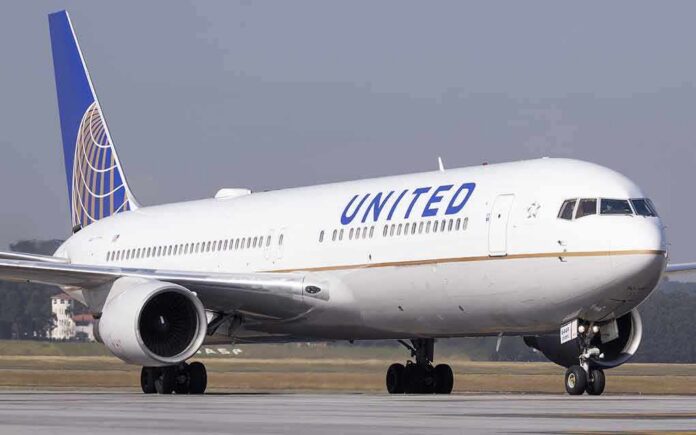
A United flight returned to Las Vegas after a flight attendant saw a text that said the sender would hijack the plane and “crash” a row, triggering a terrorism arrest.
Story Highlights
- A flight attendant reported a passenger’s text about hijacking; the pilot turned back to Las Vegas.
- Police arrested 25-year-old Dante Milne on a terrorism-related threat charge after landing.
- Air traffic control audio captured the pilot citing the hijacking text as the reason to return.
- The plane landed safely; about 150 passengers and crew were unharmed.
Pilot Turned Back After Crew Spotted Hijacking Text
United Flight 1681 departed Las Vegas for Newark when a flight attendant reported seeing a passenger’s phone with a message about hijacking the plane. The cockpit treated the report as an active security concern and turned the aircraft back roughly 10 minutes after takeoff, consistent with safety protocols. Air traffic control audio captured the pilot stating, “The flight attendant saw him texting that he was going to hijack the aircraft,” confirming the reason for the diversion.
United later described the event as a “potential security concern.” The plane landed safely at Harry Reid International Airport, where law enforcement met the flight at the gate. The prompt response showed the layered system at work: cabin crew observed a threat, the cockpit made a quick decision, and ground teams were ready. This is how aviation is supposed to work when safety signals appear in flight, even if the alarm turns out not to be an imminent attack.
Arrest and Reported Messages That Raised Alarms
Las Vegas police identified the passenger as 25-year-old Dante Milne, who was detained after landing and booked on suspicion of making a threat or providing false information about an act of terrorism, a serious state charge. Reports citing a criminal complaint say the messages included “gonna hijack this” with an expletive, and “crash ur row only,” language that raised the urgency of the crew response and the law enforcement decision to arrest.
Authorities did not report any injuries or loss of control on the flight. News accounts indicate about 150 passengers and six crew members were onboard, and the aircraft returned without incident. The flight was later reported to have continued to Newark the next morning, underscoring that the immediate threat phase ended with a controlled outcome once the crew executed the return and authorities removed the suspect.
Why Crews Must Act Fast On Explicit Threats
Flight crews train to act first and sort details later when faced with clear threat language. After decades of security reforms, crews follow a simple rule: treat a hijack reference as real until proven otherwise. That standard aims to protect lives, deter malicious actors, and prevent copycats. History shows why. The United States endured many hijackings in the past, and systems today handle explicit threats with great caution to avoid any chance of a repeat.
United Airlines 737 Pilots Returns to Las Vegas After Potential Hijack Threat✈️@united Airlines (UA) flight 1681 returned to Harry Reid International Airport (LAS) in Las Vegas on Saturday, October 24, 2026, after a flight attendant reportedly spotted a passenger texting about… pic.twitter.com/pEcqv1UVSD
— Aviation A2z (@Aviationa2z) October 26, 2026
Officials will review evidence and testimony to decide the case. A criminal charge is not a conviction, and investigators will determine intent and context. But the in-flight decision standard is different. The captain must protect the cabin and the cockpit in real time. In this case, the process worked: a warning was reported, the jet returned, police acted on arrival, and every passenger went home safe that night or the next day.
Sources:
cbsnews.com, balleralert.com, ground.news