

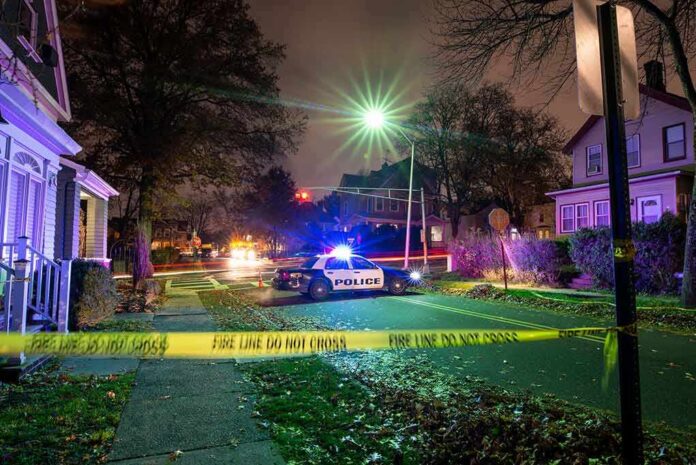
A six-day manhunt in Massachusetts ended after police said a woman suspected in a Worcester officer’s death was found dead.
Story Highlights
- Worcester Police found veteran Patrolman Kurt Solomon dead at his home after a 5:28–5:30 a.m. call.
- Police identified his wife, Karen Solomon, as a suspect and warned she was armed and dangerous.
- An arrest warrant later charged her with two counts of assault and battery with a dangerous weapon.
- Authorities said the multi-agency search spanned local, state, and federal units.
Police Response And Discovery At Wildwood Avenue
Worcester Police said officers responded to a home on Wildwood Avenue around 5:28–5:30 a.m. and found a man dead inside. Officials and local coverage identified the victim as Patrolman Kurt Solomon, a 31-year veteran of the Worcester Police Department. City Manager Eric D. Batista publicly mourned Solomon’s death and noted his decades of service to the city. Police leadership said the investigation began as a domestic-incident matter, which limited what they could share under state domestic-violence rules.
Investigators released video images showing Karen Solomon walking away from the home toward Westcott Street, and they asked the public for tips. The Worcester County District Attorney, Joseph Early Jr., said Karen Solomon was a suspect and that police wanted her for questioning because she had been at the house. Early reports from several outlets showed some timeline confusion, but all agreed on the core facts: an officer was dead and his wife was being sought.
Suspect Status, Warrant, And Charges Announced
Police said Karen Solomon should be considered armed and dangerous as the search widened across Worcester neighborhoods. After several days, Chief Paul Saucier announced that a judge had issued an arrest warrant charging Karen Solomon with assault and battery with a dangerous weapon and assault and battery with a dangerous weapon causing serious bodily injury. Those are serious felonies. They are not homicide counts, and officials did not release a cause of death in the early stage of reporting.
Authorities emphasized that the case remained active and that investigators were still building the record. Officials cited domestic-violence confidentiality as a reason for holding back details about evidence and the precise manner of death. That approach is common in sensitive home investigations while forensics, autopsy findings, and scene analysis proceed. Police kept urging residents to stay alert and share information that could lead to Karen Solomon’s location.
Large Interagency Search And Public Safety Messaging
The search for Karen Solomon grew to include local officers, the Massachusetts State Police, and federal partners. News reports named the United States Marshals Service, Customs and Border Protection, and Homeland Security Investigations among the agencies involved. Officials framed the “armed and dangerous” warning as a public-safety step while they canvassed the area and examined leads. That language often appears in domestic-incident cases that move fast in the first hours and days.
🇺🇸 They hunted her for nearly a week after her cop husband was found dead in their home… Today the search ended in the woods outside Worcester, Massachusetts.
Karen Solomon is believed to be dead, as she had a gun right beside her.
Police are calling it a murder-suicide, but… pic.twitter.com/CLk098cy21
— Mario Nawfal (@MarioNawfal) August 25, 2026
While the department sought the suspect, city leaders honored Patrolman Solomon’s service and asked for patience. The city’s statement highlighted his 31 years in uniform and the impact of his loss on colleagues and neighbors. Police said the public should avoid rumor and instead rely on official updates as they worked to secure the scene, collect digital video, and interview witnesses. Reporters noted that the timeline and specific evidence details would come into focus through formal releases.
What This Case Shows About Domestic-Incident Investigations
Domestic-incident scenes are high-risk and evidence-sensitive. Investigators often start with broad alerts, then tighten charges as lab and medical findings arrive. That is what happened here: an urgent citywide search, followed by a specific warrant on assault and battery with a dangerous weapon. Research shows many homicides worldwide involve intimate partners, which explains why departments move quickly to protect the public and secure evidence in these cases. One brief note: early cause-of-death details were not released by officials.
Sources:
nepba.org, cnn.com, bostonglobe.com, worcesterma.gov, bostonherald.com, nbcboston.com, youtube.com, theguardian.com, wcvb.com