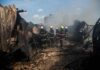


Iran’s Islamic Revolutionary Guard Corps says it fired missiles and drones at U.S.-linked sites across the Gulf and Jordan, and claims the Strait of Hormuz is shut.
Story Highlights
- Iran’s Islamic Revolutionary Guard Corps claimed strikes on U.S.-linked targets in Jordan, Kuwait, Oman, Bahrain, Qatar, and the United Arab Emirates.
- Iran asserted it hit a command center in Jordan and a radar site in Kuwait, and declared the Strait of Hormuz closed.
- Regional governments reported intercepts and condemned the attacks as hostile aggression.
- Analysts note Iran often overstates battlefield damage, with verification lagging behind claims.
IRGC Claims Multi-Country Strikes And Closure Of Hormuz
Iran’s Islamic Revolutionary Guard Corps announced missile and drone attacks against U.S.-linked facilities in several Gulf states and Jordan, following recent U.S. strikes on Iranian sites. The group said it destroyed a command and control center and drone hangars in Jordan, targeted a U.S. radar site in Kuwait, and hit additional locations in Bahrain, Qatar, Oman, and the United Arab Emirates. It also declared the Strait of Hormuz closed to all traffic, heightening concerns about energy flows and regional trade.
Middle East Eye reported the claims in detail, matching a pattern of Iranian announcements after U.S. or Israeli actions in the region. The announcement framed the attacks as retaliation. The breadth of targets, if confirmed, would mark one of Iran’s widest strike packages against U.S.-linked sites in years. The claim of closing the Strait of Hormuz, a key oil route, adds pressure on global markets and on allied navies that ensure freedom of navigation in the Gulf waterway.
Regional Responses And Air Defense Intercepts
The United Arab Emirates Ministry of Foreign Affairs publicly condemned the renewed Iranian attacks and affirmed the country was in a defensive posture against the aggression. The ministry rejected any targeting of civilian sites and called for regional restraint while stressing national defense readiness. Gulf partners hosting U.S. forces have focused on air defense, missile interception, and public warnings to keep civilians safe as debris risks rise from intercept operations over populated areas.
Independent conflict trackers and military analysts say Gulf states, working with U.S. forces, have intercepted large numbers of incoming threats across multiple rounds of attacks this month. Reports describe layered air defenses engaging ballistic missiles and drones, aiming to protect bases, ports, and energy infrastructure. These defenses help reduce damage but strain interceptor stockpiles and crews. Continuous alerts and shoot-downs also disrupt daily life and commerce across the region during each escalation cycle.
Claims, Verification, And The Information Battlespace
Security researchers note Iran often conducts asymmetric information warfare, pushing quick claims of success while independent verification lags. Since 2020, Iran has issued many bold statements about damage to U.S. and allied assets that later proved exaggerated or only partly accurate. The current claims about destroyed command nodes and radar systems fit this pattern. Verification usually follows from satellite images, local statements, or U.S. military reporting days after initial announcements.
This gap matters for American interests and energy markets. Traders react to early claims, while navies and insurers need proof to adjust posture and premiums. The United States and partners prioritize facts on the ground, not just rhetoric. That is why officials stress measured assessments and steady defense operations. Clear, verified reporting helps avoid panic, keeps tankers moving, and protects service members who stand watch at bases from Jordan to Kuwait and along key sea lanes.
Strategic Stakes For The United States And Allies
U.S. leaders aim to keep sea lanes open, protect American personnel, and deter further attacks. The claim that the Strait of Hormuz is closed challenges freedom of navigation, a core American interest. Any sustained disruption would affect global fuel prices and supply chains. Gulf allies depend on predictable shipping and air traffic to sustain their economies. Continued missile fire raises the risk of miscalculation, civilian harm, and wider war if debris or errant strikes hit cities or critical infrastructure.
🚨 BREAKING: Iran Turns Kuwait Into a Warzone – Direct Strikes on U.S. Forces 🇮🇷🇰🇼
Tehran just escalated hard: Coordinated missile & drone barrages slammed U.S. troops, Patriot systems, radar sites, and logistics hubs in Kuwait.The IRGC and Iranian Army released synchronized… pic.twitter.com/F0C3dFfKaX
— Ameena Akthar (@amyak397) July 13, 2026
Conservatives will see a clear test here: defend American forces, back allies, and keep energy flowing. That means maintaining missile defenses, sharing intelligence, and keeping pressure on those who threaten shipping. It also means calling out propaganda that inflates battlefield wins to rattle markets and intimidate partners. Facts, not boasts, must drive U.S. and allied choices. Washington and regional capitals are tracking damage reports and interceptions to guide responses that protect American lives and preserve stability.
Sources:
youtube.com, middleeasteye.net, report.az, acleddata.com