

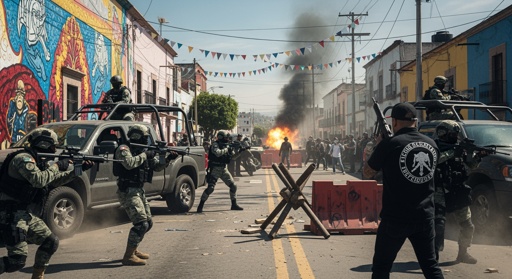
A Colombian national recruited to protect municipal officials in Mexico instead found his passport confiscated and himself deployed to monitor drug trafficking airstrips with surveillance drones under the command of one of the country’s most dangerous cartel leaders.
From Self-Defense to High-Tech Criminal Enterprise
The Cártel de Tepalcatepec started as a self-defense group in Michoacán’s Tierra Caliente region between 2013 and 2014, arising during violent conflicts over avocado and lime territories. The organization evolved into a faction of Cárteles Unidos, transforming from community protectors into sophisticated criminal operators. Led by Juan José Farías Álvarez, known as El Abuelo, the cartel now battles the Jalisco New Generation Cartel for control of lucrative drug trafficking routes and agricultural extortion rackets. This transformation mirrors a disturbing pattern across Mexico where vigilante groups become indistinguishable from the criminals they claimed to oppose.
The Dangerous Deception Behind Recruitment
A Milenio Noticias investigation exposed the recruitment tactics used to ensnare foreign nationals. Journalist César Cabrera interviewed a Colombian national who accepted what he believed was legitimate security work protecting municipal officials. The promises evaporated upon arrival in Michoacán. Cartel operatives, including a recruiter known as La Roca, immediately confiscated his passport and reassigned him to drone surveillance operations. For two months, he monitored airstrips used for drug flights in the Tierra Caliente region, particularly around Apatzingán. The testimony reveals a calculated bait-and-switch operation that exploits skilled workers seeking employment, then traps them in criminal activities through coercion and document seizure.
Colombian Expertise Transforms Cartel Capabilities
The influx of Colombian mercenaries, many with military backgrounds, fundamentally changed the nature of cartel warfare in Michoacán. These foreign specialists brought expertise in explosives, improvised explosive devices, and advanced surveillance techniques previously unavailable to Mexican criminal organizations. Leaked documents from the Guacamaya intelligence breach revealed that by late 2021, a Tepalcatepec member nicknamed Kamoni had already employed 26 Colombians as guerrillas against the CJNG. Arrests in October of a Colombian known as El Llanero, or Jhon Mario N, exposed training operations for hitmen in IED construction. These devices appear in drones, mortars, and landmines used for lime extortion throughout the region.
Drones Become Daily Tools of the Drug Trade
Mexican cartels now deploy drones almost daily for surveillance, drug smuggling, and attacks against rivals and authorities. Steven Willoughby, a Department of Homeland Security deputy, testified before Congress about the frequency of cartel drone operations along the border. The Mexican army responded by deploying counter-drone systems across Sinaloa, Jalisco, and Michoacán. Agricultural drones adapted to carry explosives have caused airspace disruptions, including closures near El Paso. The CJNG pioneered drone warfare in the region, prompting rival organizations like Tepalcatepec to recruit specialists who could match these technological capabilities. Real-time monitoring of Border Patrol movements and rival cartel positions gives operators significant tactical advantages in an increasingly sophisticated criminal landscape.
The Human Cost of Technological Warfare
Lime and avocado farmers in Michoacán face extortion backed by drone surveillance and landmine threats installed by foreign bomb-makers. Local ranchers report noticing different kinds of people in their communities, often identified by foreign accents that signal the arrival of explosive devices and increased violence. The shift from traditional shootouts to mine warfare has killed soldiers and civilians, fundamentally altering daily life in Tierra Caliente. Mexican Security Minister Omar García Harfuch announced the 2025 arrest of 78 South Americans connected to explosives training and cartel integration, yet the recruitment continues. The economic disruption extends beyond agriculture to drug flight operations, while social fear permeates communities where improvised explosive devices can appear anywhere.
A Pattern That Demands Attention
The globalization of cartel operations through foreign mercenary recruitment represents more than tactical evolution. It demonstrates how transnational criminal organizations exploit porous borders, economic desperation, and specialized military skills to enhance their capabilities against both rivals and governments. The United States has placed rewards on leaders like El Abuelo, yet the incentives fail to stem the tide of recruitment or technological advancement. Counter-drone efforts and mass arrests address symptoms rather than causes. The normalization of foreign combatants in Mexican cartel operations, combined with daily drone surveillance and IED deployment, signals a troubling escalation that threatens regional stability and challenges traditional law enforcement approaches designed for less sophisticated criminal enterprises.
Sources:
How Mexican cartels employ drones as tools to smuggle drugs and fight enemies
Mexican authorities arrest man linked lime farmer extortion cartel recruitment explosives
We’re part of the Jalisco Cartel: Mexico concerned by influx of Colombian mercenaries
Mexico cartel land mines weapons