

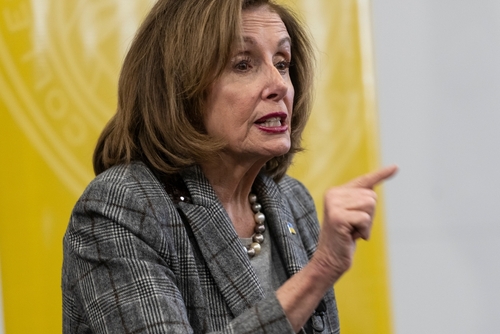
A former Alexandria Ocasio-Cortez insider just torched millions of dollars trying to replace Nancy Pelosi—and still could not win a single precinct in deep-blue San Francisco.
Story Snapshot
- Saikat Chakrabarti, ex–chief of staff to Alexandria Ocasio-Cortez, spent millions running for Nancy Pelosi’s old House seat and finished a distant third.
- Reports say he poured roughly $8–10 million of his own fortune into the race, yet pulled only about 15 percent of the vote and missed the general election.
- The campaign mixed a national left-wing brand, big money, and an army of staff and volunteers—but could not overcome local political realities or establishment pushback.
- The race highlights how both parties’ primaries have become playgrounds for wealthy political insiders while regular Americans struggle to afford basic needs.
How a High-Dollar Progressive Bid Crashed in San Francisco
Former Alexandria Ocasio-Cortez aide Saikat Chakrabarti ran in the June 2026 primary to succeed retiring Representative Nancy Pelosi in California’s 11th Congressional District, which covers San Francisco.[1] New York Post reporting says he spent about $10 million of his own money trying to win the seat.[1] Despite that massive budget, early returns showed him stuck at roughly 15 percent of the vote, far behind State Senator Scott Wiener at about 41 percent and Pelosi-backed Supervisor Connie Chan near 29 percent.[1] Those two advanced to the November general election while Chakrabarti was eliminated.[1]
The same report notes that Chakrabarti did not carry a single precinct in the district.[1] That is a striking outcome in one of the most progressive cities in America, especially for a candidate known nationally as a cofounder of Justice Democrats and a key strategist behind Ocasio-Cortez’s 2018 upset.[2] Jacobin magazine had framed him as a natural “slam-dunk” progressive choice on paper, backing Medicare for All, free public college, higher taxes on millionaires, and ending all military aid to Israel.[2] Yet voters chose two other Democrats, including another progressive, instead.[2]
Money, Messaging, and a Divided Left
Chakrabarti’s loss came despite a huge operation that looked, from the outside, like the kind of serious, well-funded effort many ordinary candidates can only dream of. A Semafor profile earlier in the cycle described him as a tech centimillionaire whose challenge had local power brokers on edge, especially after he vowed to take on the Democratic establishment and support primary challenges against sitting leaders.[3] Online sleuths estimated he spent at least $5 million by early 2026, with some local analysts later pegging his total near $8–10 million when the votes were counted.[10] Federal Election Commission data show his congressional committee moving serious sums through the 2025–2026 cycle, confirming that this was not a shoestring run.[6]
Yet money, on its own, did not carry the day. Jacobin reported that San Francisco’s left was split between Chakrabarti and Connie Chan, a union-backed city hall veteran who had deep local relationships.[2] Some progressives questioned Chakrabarti’s alignment with the grassroots left after he supported and donated to more moderate local candidates in earlier city races.[2] That tension reflects a broader pattern in Democratic primaries nationwide, where big-money ideological fights between moderates and progressives have drawn more than $50 million in outside spending in some recent cycles and often confuse voters who simply want practical results.[17]
What the Race Reveals About Today’s Political Class
For many Americans, the most jarring detail is the price tag. Local commentary noted that if Chakrabarti’s spending hit around $10 million, he effectively paid hundreds of dollars per vote in a losing effort.[7] At the same time, federal regulators report that House and Senate candidates together raised roughly $1.5 billion in just the first year of the 2025–2026 election cycle.[21] Political action committees pulled in another $4.6 billion.[21] Both parties now operate in a world where campaigns are massive money machines, even when they deliver little for the people footing the bill through donations, higher prices, or tax policy shaped by donors.
This race also fits a familiar story about insiders and the so-called “deep state” that frustrates both conservatives and liberals. On one hand, a wealthy, nationally connected progressive tried to channel anger at Democratic leaders he called paralyzed and out of touch.[6] On the other hand, he became yet another example of a political elite able to burn millions of dollars on a personal project while many working families cannot cover a surprise medical bill or rising rent. That gap feeds a shared sense that the system works for politicians, consultants, and mega-donors—not for the people expected to vote for them.
Why Both Left and Right See a Broken System
Research on recent primaries shows that factional fights often leave voters with nominees who excite a narrow base but struggle to address broad economic pain.[23] Many Democratic primary voters tell survey researchers they want leaders focused on results, not ideological theater.[20] At the same time, Republicans and Democrats alike now lean on super political action committees and dark-money groups that pour millions into safe districts, trying to pick winners long before regular citizens cast a ballot.[17][22] The Pelosi succession race was one more battle in that insider war.
Ex-AOC chief of staff Saikat Chakrabarti burned a record $8M+ on a failed bid to succeed Nancy Pelosi as House Democratic leader — with little to show for it. @i
Full story: https://t.co/r6qG5ydov2— Leinona Aoki (@LeinonaA69) June 20, 2026
For conservatives watching from outside San Francisco, Chakrabarti’s flop can look like karma for a left-wing architect of the Green New Deal and big-spending politics. For many liberals, it looks like proof that even a well-funded progressive with national fame cannot crack a machine that protects established power. For both, it is another reminder that the people who run Washington and shape party primaries often live in a different world from those who worry about groceries, energy bills, and basic safety. Until campaign money and insider influence shrink, stories like this will keep feeding the feeling that the federal government has lost touch with the American Dream.
Sources:
[1] Web – Staggering amount ex-AOC aide wasted on failed Pelosi succession bid
[2] Web – Ex-AOC aide Saikat Chakrabarti loses race to succeed Nancy Pelosi
[3] Web – In San Francisco, a Divided Left Eyes Nancy Pelosi’s Seat – Jacobin
[6] Web – Saikat Chakrabarti’s congressional campaign ended in resounding …
[7] Web – CHAKRABARTI, SAIKAT – Candidate overview – FEC
[10] Web – Saikat Chakrabarti’s congressional campaign ended in resounding …
[17] Web – A rainy day shouldn’t cause financial ruin. That’s why I’m fighting to …
[20] Web – Moral reframing increases support for economically progressive …
[21] Web – The Truth About Democratic Primary Voters | Third Way
[22] Web – Statistical Summary of 12-Month Campaign Activity of the 2025 …
[23] Web – Republicans have appeared to use shadowy super PACs to meddle …