

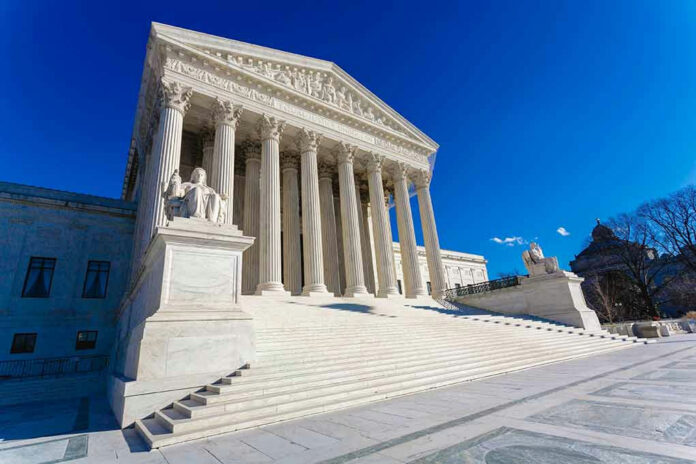
After the Supreme Court cemented birthright citizenship in a 6-3 ruling, top Democrats answered not with policy, but with fresh talk of packing the Court.
Story Snapshot
- Supreme Court ruled 6-3 to uphold broad birthright citizenship, rejecting Trump’s order.
- Democrats cheered the ruling, then renewed calls to add justices, but offered no bill text.
- Three conservative justices dissented; Justice Brett Kavanaugh concurred only in part.
- Past expansion bids fizzled; Congress holds the power but lacks consensus.
What The Court Actually Decided
On June 30, 2026, the Supreme Court ruled 6-3 that the Constitution guarantees automatic citizenship to almost all children born on United States soil, striking down President Trump’s executive order that sought to limit birthright citizenship. Chief Justice John Roberts wrote the majority opinion. The ruling leaned on the Fourteenth Amendment’s Citizenship Clause and historical practice. The decision is now binding precedent. Media and legal outlets widely reported the result and scope of the ruling.
Justice Brett Kavanaugh agreed with the outcome only on narrower grounds tied to mid-twentieth century federal law, not the full sweep of the majority’s constitutional reasoning. Justices Clarence Thomas, Samuel Alito, and Neil Gorsuch dissented in separate writings, rejecting the majority’s reading of the Fourteenth Amendment. The split shows a serious debate on text, history, and the phrase “subject to the jurisdiction” that will shape future immigration and citizenship cases the Court accepts.
How Democrats Framed The Outcome
House Democratic Leader Hakeem Jeffries declared the Court recognized that everyone born here is a citizen, with no uncertainty. Senate Democratic Leader Chuck Schumer said the Court reinforced that people born in America are part of America, despite what he cast as intimidation from Trump. Senator Elizabeth Warren argued even a Court with Trump appointees admits birthright citizenship is protected by the Constitution. Their statements underscored a political victory message after the decision.
Soon after, activists and some Democratic voices pushed again for expanding the number of justices. They framed expansion as a way to check what they call a right-leaning Court. Yet there is no new bill text, seat number, or plan on paper from leadership today. Past proposals, like the Judiciary Act of 2023 to add four seats, did not advance. Congress can change the Court’s size, but recent attempts stalled for lack of support.
Why Court-Packing Talk Matters To Voters
Court expansion would upend checks and balances. If one party adds seats after a legal loss, the other party will respond in kind. That cycle erodes trust in equal justice and turns the Court into another political body. Many conservatives see this as a threat to the rule of law and to stable rights, from free speech to the Second Amendment. The country needs judges who read the law, not a bench swollen to chase short-term wins after hard cases.
The post-ruling calls also distract from border and immigration policy that Congress can actually fix. A secure border, clear asylum rules, and strict work enforcement remain urgent. Lawmakers can tighten loopholes, fund enforcement, and reform legal pathways without touching the Constitution. Real debate over jurisdiction, domicile, and fraud prevention belongs in lawmaking, not in a race to add robes when a case does not go one side’s way.
What The Conservative Case Argues
The Trump administration’s executive order argued that the Citizenship Clause was written to cover freed slaves, not children of people who are here unlawfully or only briefly. It read “subject to the jurisdiction” to require lawful permanent ties. That position lost, but it was specific and grounded in text and history. The government’s brief laid out that framework for the Court to consider before the justices divided in their final opinions.
Today’s precedent is clear. But the debate over original meaning and the reach of “jurisdiction” will not fade. Congress remains free to write tighter laws consistent with the ruling’s boundaries. Voters should press Congress to deliver border security, track overstays, and stop abuse of birth tourism. The right path is transparent legislation, not structural attacks on the Court that weaken faith in our system and invite endless escalation.
What Happens Next And What To Watch
Expect more headlines about expanding the Court. Yet watch for concrete steps, not slogans. There is no new public bill text, no seat number, and no detailed legal defense from leaders explaining why expansion would fix anything. The last several cycles show that big expansion pushes usually fade once they meet public scrutiny and the reality of Congress. That pattern held even when Democrats controlled both chambers earlier in the decade.
CURRENT NEWS REPORT — TUESDAY, JUNE 30, 2026
1. SUPREME COURT UPHOLDS BIRTHRIGHT CITIZENSHIP
The U.S. Supreme Court ruled today that President Donald Trump’s executive order restricting birthright citizenship cannot stand.
The ruling was 6–3.
The order would have denied… pic.twitter.com/ib5uzxsLCH
— Ernie Milleur (@ErnieMilleur) July 1, 2026
For conservatives, the mission is steady: secure the border, enforce the laws, and keep the Court independent. Support members who will write serious immigration reforms and defend the separation of powers. Reject court-packing schemes that turn judges into partisans. Hold leaders to the same standard you expect from the Court: follow the text, face the facts, and do the hard work in the open. That is how we protect the Constitution for our families and our future.
Sources:
npr.org, constitutioncenter.org, aclu.org, law.cornell.edu, theusconstitution.org, cambridge.org