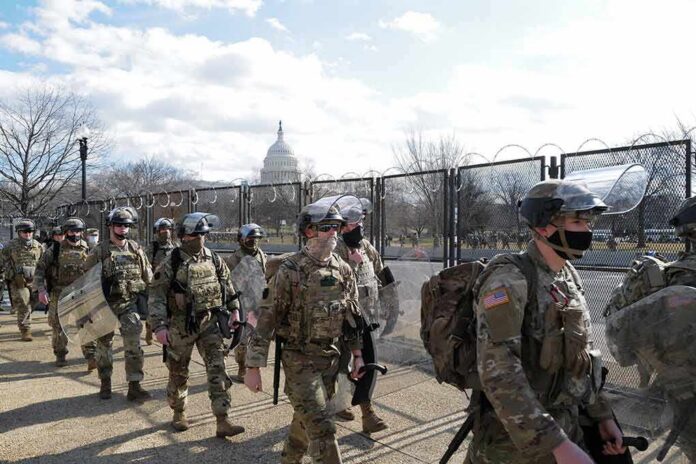
Two signed Pentagon memoranda cleared the D.C. National Guard to use marked patrol cars, tactical vehicles, boats, and light towers on Washington streets.
Story Snapshot
- Memoranda dated October 29 authorize up to 60 marked patrol cars and other gear.
- Two National Guard patrol boats will provide maritime support near the Anacostia.
- All vehicles must be clearly marked “National Guard,” and troops must be in uniform.
- Multiple outlets reported the same core details and date across independent coverage.
Hegseth Signs Off On Expanded Guard Equipment In D.C.
Associated Press reported that Defense Secretary Pete Hegseth signed two memoranda on October 29 authorizing the D.C. National Guard to use marked patrol cars, military tactical vehicles, patrol boats, and portable light towers during increased patrols in the nation’s capital. Stars and Stripes and Politico separately reported the same core authorization and date, reinforcing the scope and timing. The move expands the tools available to Guard troops who have supported public safety missions under federal direction in Washington since last year.
The Hill quoted a Pentagon official who said the guidance allows up to 60 marked patrol cars, military tactical vehicles, and up to 20 light towers and generators, along with D.C. National Guard maritime boat assets, in support of federal and local law enforcement operations. Associated Press added that two patrol boats would provide operational maritime support. Those boats can help secure river edges and aid partner agencies if suspects flee across waterways, according to the reporting.
Markings, Uniforms, And Support Role Define The Mission
The memoranda require that every patrol car be marked “National Guard,” and that troops operate in uniform, according to Associated Press. Those directions make the mission visible to the public and underscore that Guard troops support, not replace, civilian police. The reporting does not list every model of tactical vehicle, and outlets differ on whether boats focus on perimeter security or potential river pursuits. But all coverage frames the role as operational support to law enforcement, not standalone policing.
Reporters describe authorization ceilings, not full deployment counts. That means up to 60 patrol cars and up to 20 light towers are approved, but not all may be fielded at once. This approach is common in contingency planning. Commanders can scale assets to events, weather, and partner needs. Multiple outlets note the same October 29 date and equipment categories, which anchors the facts even as precise vehicle types, serial numbers, or daily usage logs are not in public view.
How This Fits Within Long-Running Guard Support Debates
Congress’s research arm explains that the key legal line is between support to civilian law and direct execution of civilian law. The Posse Comitatus Act restricts using federal military forces to enforce domestic law, with narrow exceptions. The National Guard, when not federalized, operates under different authorities, but the same caution applies: support roles are more common than direct enforcement. Marked vehicles, uniformed status, and partnership with police are consistent with a support posture.
Washington is unique because the federal government, not a governor, oversees the D.C. National Guard. Courts and policymakers have wrestled with the scope of that authority during the past year. Appeals, injunctions, and policy guidance shape day-to-day practice while cases move forward. Within that context, the October 29 memoranda define tools and visibility rules for patrols, boats, and lighting, while keeping command and coordination with civilian agencies at the forefront of operations.
Security Priorities And Accountability Measures
Officials are leaning on tools that show up on the street and along the river at night: marked cars, tactical vehicles for rough terrain or barriers, boats for river edges, and light towers to push back darkness. These items deter crime, help responders move safely, and make patrols easier to spot. The visible markings and uniform rules also help neighbors tell a Guard unit from a police cruiser. Clear signs reduce confusion and support public trust during joint operations.
United States Expanded National Guard patrols in Washington DC have been approved. New equipment includes light towers, dozens of vehicles, patrol boats, and the arming of some soldiers with rifles. Currently they are mostly military police, specially trained on and carrying… https://t.co/86aiw0sThl
— AVSEC Pro (@avsec_pro) November 7, 2026
Multiple newsrooms reported the same documents and central facts, which makes the record strong on what was authorized and when. Some details remain operational, such as exact vehicle models or how many units roll on a given shift. That is normal for security planning. The bottom line is simple: the Pentagon approved a larger kit for Guard support in D.C., capped the numbers, required visible markings, and put boats on call to back up law enforcement along the water.
Sources:
zerohedge.com, apnews.com, stripes.com, clickondetroit.com, washingtonexaminer.com, courthousenews.com, axios.com