

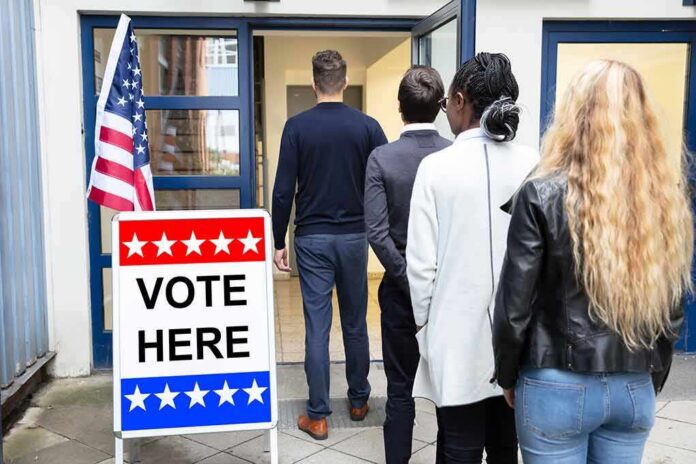
An Alaska election official formally ruled a “Dan Sullivan” candidacy was set up to mislead voters, and now subpoenas could expose who pulled the strings.
Story Highlights
- Alaska’s elections chief found Daniel J. Sullivan’s candidacy aimed to confuse voters.
- A federal lawsuit seeks to pause certification to check for mistaken votes.
- Gov. Mike Dunleavy ordered a state probe that could bring subpoenas.
- Court rulings kept the candidate on the ballot, deepening the conflict.
State Finding: Candidacy Intended To Mislead
Alaska Division of Elections Director Carol Beecher issued a June 15, 2026 determination that Daniel J. Sullivan was not running in good faith. The decision said the filing aimed to confuse or mislead voters and compromise the fairness of the ballot. Officials pointed to choices that made him look like incumbent Senator Dan Sullivan. Those included using the name “Dan Sullivan,” changes in party status, and branding that echoed the senator’s campaign, according to related filings and reports.
The Division of Elections removed Daniel J. Sullivan from the ballot. A trial court reversed that action. The Alaska Supreme Court affirmed the reversal, which put him back on the ballot. Those rulings did not erase the original finding about misleading intent. They instead set the legal ground for election day and forced the fight into other forums.
Federal Lawsuit: Certification On Hold If Confusion Skewed Votes
The Department of Justice filed United States v. State of Alaska on October 22, 2026. The complaint asks a court to hold certification if Senator Dan Sullivan narrowly loses. It seeks time to determine whether votes cast for Daniel J. Sullivan were actually meant for Senator Sullivan. The case rests on the risk that name similarity and presentation caused real voter confusion under Alaska’s ranked-choice rules.
The federal complaint does not claim final proof of confused votes. It requests an investigation to measure voter intent before the state locks in results. That approach aims to protect lawful votes and prevent an election outcome shaped by a look-alike on the ballot. Critics argue timing is close to the election, but the filing’s remedy focuses on accuracy, not advantage.
State Investigation: Subpoenas And Evidence Trail
Governor Mike Dunleavy directed the Alaska Department of Public Safety to probe whether the scheme broke state law. He said investigators will decide if criminal charges or civil action are warranted, and that evidence will drive the next steps. That mandate opens the door to grand jury subpoenas for emails, texts, call records, consulting contracts, and payment trails that could show who planned the identity tactics and why.
Reports describe allegations that allies of Democratic candidate Mary Peltola encouraged the run. Her campaign and the Democratic Senatorial Campaign Committee deny recruiting Daniel J. Sullivan. A former campaign manager reportedly said Peltola was aware of the effort but not directly involved. Daniel J. Sullivan has denied running at Democrats’ behest. The public record has not produced the recruiting emails, payments, or contracts that would prove coordination.
What Is Known, What Is Missing
What is established: the election director’s written finding of intent to mislead; a court path that kept the candidate on the ballot; a federal case that could pause certification to test voter intent; and a state probe that may use subpoenas to gather records. What is not yet shown: a direct, documented link tying the Peltola campaign or national Democrats to recruiting, paying, or managing Daniel J. Sullivan’s effort. That gap is where investigators will focus.
Alaskans deserve elections where names, labels, and designs do not trick voters. Election integrity means every legal vote counts as the voter meant it. President Trump’s Justice Department moved to guard certification from confusion, while Alaska’s governor set state officers on the facts. If subpoenas surface coordination or deception, charges or civil action should follow. If not, the probes can close. Either way, sunlight and records—not spin—must settle this race.
Sources:
facebook.com, forbes.com, elections.alaska.gov, juneauindependent.com, nbcnews.com