
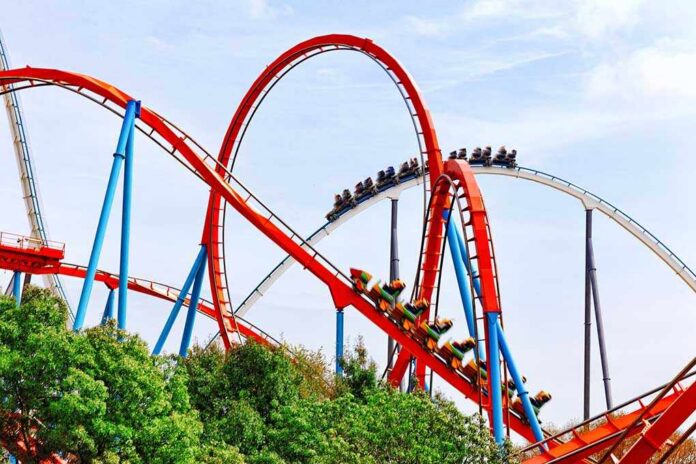
Witnesses say a man fell from Six Flags Over Georgia’s Goliath roller coaster, and police confirmed one person died as riders were evacuated and several others were hurt.
Story Snapshot
- Cobb County authorities confirmed one death after an incident on the Goliath roller coaster.
- Witnesses reported a rider fell; several people were injured, and riders were later rescued from stalled cars.
- Six Flags expressed condolences and said it is cooperating with the investigation.
- Amusement-ride fatalities are rare, but a full review by local investigators is under way.
Police Confirm Fatality, Begin Major Crimes Investigation
Cobb County police said a person died after an incident involving the Goliath roller coaster at Six Flags Over Georgia in Austell. Officers reported several injured people and an emergency response that began just before 4:00 p.m., prompting evacuations from the ride and elsewhere in the park. Police said the department’s Major Crimes Unit opened an investigation, which is standard after a death in a public venue. Officials did not release the victim’s name, pending family notification.
Local outlets reported that guests were escorted off the ride after it stopped with cars on an incline. Witnesses told reporters they saw a rider fall and strike parts of the structure before landing in a wooded area, which aligns with the scope of the police response on site. First responders used ladders and platforms to bring riders down safely from halted trains. Park operations were disrupted as emergency crews worked, and authorities secured the area for investigators.
Six Flags Statement and On-Scene Response
Six Flags Over Georgia issued a statement expressing deep sadness and condolences to the guest’s family and friends. The park said its team responded with local authorities and is cooperating with the investigation, which will determine what caused the deadly incident. The company did not identify any mechanical issue or operator error at this stage. Park communications stressed that guest and team member safety is the top priority as the review proceeds.
Park staff and first responders moved quickly to stabilize the scene, treat the injured, and evacuate riders from stalled coaster trains. Emergency teams typically secure power, assess restraints, and use harnesses or stair systems built into larger coasters to bring riders down. That process takes time, and officials kept guests back to protect both the public and the integrity of the investigation. Authorities asked anyone with direct video or first-hand information to contact detectives.
What Investigators Will Examine Next
Investigators will look at several factors: the ride’s restraint system, maintenance logs, operator procedures, and the rider’s actions and condition. These steps are standard after a serious ride incident. Detectives and technical specialists will likely review surveillance video, interview witnesses and staff, and document every inch of the train involved. That work helps determine whether a mechanical failure, rider conduct, a medical issue, or another cause led to the fall. Findings often take days or weeks to finalize.
BREAKING NEWS: A tragic safety incident occurred today on the Goliath roller coaster at Six Flags Over Georgia, resulting in one fatality and four injuries. In this video, we break down exactly what happened! https://t.co/gqUbfH39L4 pic.twitter.com/BnicN9G7Xv
— Shannel TV (@ShannelTV) October 13, 2026
Context helps frame the risk picture. A United States Consumer Product Safety Commission study estimated 71 nonoccupational amusement-ride fatalities from 1987 through 2002, averaging about 4.4 deaths a year across mobile and fixed-site rides. Industry data describe serious injuries on fixed-site rides as rare, citing a low chance per ride taken, though definitions vary and reporting can lag. Even with low base rates, a fatal incident demands a complete, transparent review that delivers clear answers and accountability.
Safety Standards, Liability, and Accountability
Fixed-site amusement parks operate under state and local oversight, third-party inspections, and strict internal protocols. Courts have wrestled with the legal duty these venues owe guests, with some jurisdictions holding parks to very high care standards for rider safety. Regardless of legal labels, the practical expectation is simple: restraints must hold, operators must follow procedure, and equipment must meet the highest safety bar every single cycle. Any gap in that chain can have tragic results.
Families trust that when they buckle in, the system works as designed. That trust is earned by rigorous maintenance, vigilant training, and honest reporting. Investigators will test whether the Goliath train and restraints performed to spec, whether staff followed every step, and whether anything unusual occurred with the rider. If faults are found, the public should expect prompt fixes, open findings, and, if warranted, civil or criminal accountability. That is how safety culture stays real, not just promised.
Why This Matters to Families and Communities
Parents want safe, affordable fun close to home. When a ride fails or a tragedy strikes, it shakes that sense of normal life. Communities rely on clear facts, not spin. The fastest way to restore trust is a thorough, public accounting and tangible safety actions. Theme parks are part of American family life, and most visits end with smiles. But this death is a solemn reminder: vigilance, transparency, and responsibility are non-negotiable on high-speed rides built for thrills.
Officials have not yet released a cause. Police and park cooperation is essential, and the family deserves straight answers. The public should expect regular updates from authorities as they confirm the timeline, the mechanics, and any contributing factors. Until then, prayer and support for the victim’s loved ones come first, and a firm resolve to ensure that every rider who boards a coaster can step off safely every time.
Sources:
foxnews.com, wrbl.com, 41nbc.com, 11alive.com, nbcnewyork.com