
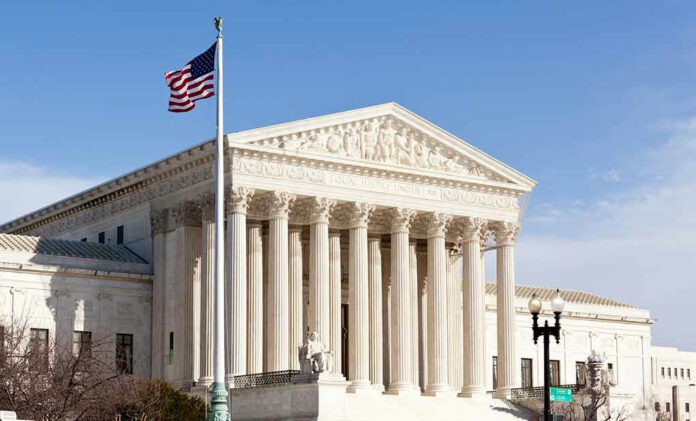
A coming Supreme Court ruling on President Trump’s birthright citizenship order could reshape who becomes an American at birth—and how far our Constitution still protects the nation from border chaos.
Story Snapshot
- The Supreme Court is weighing Trump’s 2025 executive order that narrows birthright citizenship for children of illegal and temporary visitors.
- The fight centers on the Fourteenth Amendment phrase “subject to the jurisdiction,” last addressed in depth in an 1898 case.
- Lawsuits from left-leaning groups paint the order as unconstitutional, while Trump’s team says it restores the amendment’s original meaning.
- The Court’s decision will affect not just immigration, but election maps, welfare spending, and the balance of power between states and Washington.
Trump’s Order Targets Birth Tourism and Illegal Entrants
On his first day back in office in January 2025, President Trump signed Executive Order 14160, titled “Protecting the Meaning and Value of American Citizenship.”[1] The order says that most children born here are citizens, but it carves out two key groups. It denies automatic citizenship to babies whose mothers are in the country illegally and whose fathers are not United States citizens or lawful permanent residents.[1][5] It also blocks citizenship for babies whose mothers are here only on a temporary legal stay, such as a student or work visa, when the father is also not a citizen or permanent resident.[1][5][6] The order tells federal agencies to stop issuing passports, Social Security numbers, and other federal documents that recognize these newborns as citizens, starting 30 days after the order took effect.[1][5][6] Local governments would still issue birth certificates, but those certificates would no longer serve as proof of citizenship on their own.[1]
Trump frames this as a fight to stop “birth tourism” and large-scale illegal immigration abuse of our laws.[1][6] His legal team argues that the Fourteenth Amendment was written after the Civil War to protect newly freed slaves and their children, not to offer instant citizenship to the children of people who broke our laws to get here.[6] In their Supreme Court brief, government lawyers say the phrase “subject to the jurisdiction thereof” was never meant to cover children of illegal entrants or short-term visitors.[6][7] They argue that the core rule has always been citizenship for children born here to parents who are lawfully and permanently settled in the United States, not those just passing through or defying immigration rules.[6]
A Century‑Old Precedent Meets a Modern Border Crisis
Opponents of the order lean heavily on a 1898 Supreme Court case, United States v. Wong Kim Ark, which involved a man born in San Francisco to Chinese parents who were long‑term residents but not citizens.[6][7] The Court ruled that he was a citizen at birth, and that decision has been treated for more than a century as the main guide on birthright citizenship.[6][7] The State Department’s own Foreign Affairs Manual cites the case as holding that people born in the United States and subject to its jurisdiction are citizens, with narrow exceptions like children of foreign ambassadors.[7] Civil rights lawyers now claim this ruling guarantees citizenship to almost everyone born on United States soil, including children of illegal immigrants and temporary visitors.[2][6]
Legal advocates such as the American Civil Liberties Union call Trump’s order a direct attack on the Fourteenth Amendment and long‑standing law.[2][3] They argue that the Constitution’s text, Supreme Court precedent, and federal statute all protect automatic birthright citizenship for nearly all babies born here, regardless of their parents’ status.[2][3][6] Their nationwide class action, Trump v. Barbara, speaks for families who say the order strips their children of rights and will throw their lives into legal chaos.[2][3][5] These groups also warn that if the government can deny birthright citizenship by executive order today, a future left‑wing president could rewrite other core rights tomorrow, without going through Congress.[2][6]
How the Supreme Court Has Handled the Order So Far
The legal fight has already produced a maze of rulings. In June 2025, the Supreme Court issued a 6–3 decision that allowed Trump’s order to take effect in states that did not challenge it, while blocking nationwide orders that had stopped enforcement everywhere.[4] The Court said lower judges had gone too far with broad national injunctions, limiting them to the parties before the court.[1][4] That ruling did not decide whether the order is constitutional, but it opened the door for partial enforcement and set the stage for the current, bigger case.[1][4] Immigrant‑rights advocates quickly filed a new nationwide class action, and by July 2025 the Court had preliminarily blocked the order again while allowing a large class of affected children to be represented.[3]
The current Supreme Court case, again titled Trump v. Barbara, was argued in April 2026 and focuses squarely on the meaning of the Citizenship Clause and the limits of executive power.[2][5] Government lawyers urge the justices to read “subject to the jurisdiction” more narrowly and say Congress has always had room to define who counts as “in” the United States in a constitutional sense.[6] Civil rights lawyers respond that virtually everyone born on United States soil is under United States jurisdiction, except narrow cases like children of diplomats, and that changing this rule now would break with over a century of practice and expectations.[5][7]
What Is Really at Stake for Conservatives and the Country
The outcome will decide far more than a single executive order. If the Court upholds Trump’s view, it would let the administration deny automatic citizenship to children of illegal immigrants and most temporary visitors, which could reduce incentives for crossing the border to give birth and for “birth tourism” schemes.[1][6] It would also signal that the federal government can take steps to protect the value of citizenship without waiting on a divided Congress. Many conservatives see this as a needed course correction after decades of loose enforcement and activist judges stretching the Constitution.[1][6]
If the Supreme Court strikes down birthright citizenship, all of Balogun's goals are vacated. Your move Alito
— Ser Lampy The Hostel Hedge Knight (@JustLampy) June 13, 2026
If the Court sides with the challengers, the old broad rule stays in place, and every baby born here—aside from diplomats’ children—remains a citizen at birth.[2][6][7] That would keep the current system where families can gain a long‑term foothold in the United States through a child’s citizenship, with ripple effects on welfare, schools, health care, and political representation.[1][3] It would also mark a major check on President Trump’s ability to use executive power to tackle the border crisis, leaving many conservatives feeling that the judiciary again blocked common‑sense efforts to defend national sovereignty. Either way, this decision will show whether the Supreme Court still reads the Constitution as a shield for the nation’s borders—or as a weapon against those trying to restore them.
Sources:
[1] YouTube – Birthright citizenship decision looms as Trump court cases mount
[2] Web – Supreme Court to Review Constitutionality of Birthright Citizenship …
[3] Web – Supreme Court Arguments Wrap in Landmark Challenge to Trump …
[4] Web – The Supreme Court’s Birthright Citizenship Decision Could …
[5] Web – Supreme Court Arguments Wrap in Landmark Challenge to Trump …
[6] Web – Supreme Court Expresses Skepticism at Trump’s Effort to Eliminate …
[7] Web – Birthright Citizenship Under the U.S. Constitution