

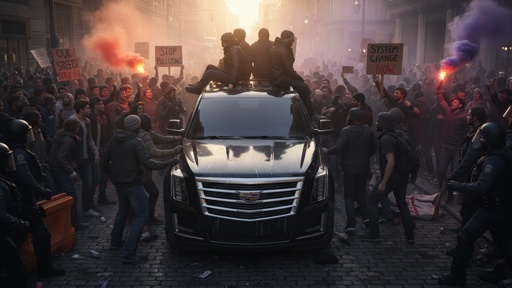
Radical activists at an elite Ivy League school boxed in their own university president’s car after an Israel‑Palestine debate, and now Cornell’s leadership has quietly admitted the students went too far without really holding them accountable.
Radical Protest Turns Into Parking Lot Showdown
On April 30, 2026, Cornell President Michael Kotlikoff left an Israel‑Palestine debate and walked to a parking lot near Day Hall, the heart of Cornell’s administration. A group of anti-Israel protesters, led by Students for a Democratic Cornell and joined by other activists, followed him from the event. Once he reached his black Cadillac SUV, protesters surrounded the vehicle, shouted at him, banged on the car, and tried to stop him from leaving the space.
Video from the scene, later circulated online and in the student press, shows students crowding around the SUV while continuing to confront the university president. Kotlikoff eventually reversed and slowly maneuvered his way out of the spot. Activists quickly claimed the vehicle struck protesters and even ran over one person’s foot, allegations that instantly became part of a broader effort to portray the president as the aggressor rather than the target of an escalating demonstration.
Investigation Clears President, Faults Protest Tactics
Cornell’s Board of Trustees responded by forming an ad hoc committee to investigate the confrontation. Over eight days, the committee reviewed surveillance footage, public videos, Cornell University Police Department reports, and available witness accounts. The trustees ultimately cleared Kotlikoff of wrongdoing, explicitly backing his integrity and leadership while noting that he had recused himself from the review. They concluded that his actions did not amount to misconduct during the tense parking lot encounter.
The committee also addressed the protesters’ claims that Kotlikoff injured them with his vehicle. Campus police and emergency medical services reported that demonstrators who claimed harm refused treatment at the scene and later declined to provide sworn statements, despite repeated requests. Without medical documentation or sworn testimony, investigators could not verify the alleged injuries. The trustees pointedly emphasized this lack of cooperation, which undercut the activists’ narrative that they were victims of a reckless administrator.
Protesters Criticized but Spared Discipline
While clearing Kotlikoff, the trustees did not give the protesters a free pass. Their statement concluded that following the president from the event, surrounding his car, and impeding his ability to leave violated Cornell’s own standards for expressive activity. They said the behavior was inconsistent with policies that prohibit intimidation and require respect for safety and movement on campus. The confrontation, they suggested, crossed a line from protest into harassment aimed at a single individual.
Despite that finding, neither the trustees nor Kotlikoff chose to pursue formal discipline or charges. The board announced that protesters, including non-student participants, would not face penalties. Kotlikoff himself declined to file complaints, even after publicly labeling the incident “harassment and intimidation” in a May 1 statement. For many observers who see campus standards regularly used against conservative or pro-Israel voices, that decision raises questions about whether radical left groups continue to enjoy informal immunity.
Free Speech, Intimidation, and a Warning for Campus Culture
The incident unfolded immediately after a debate series that was deliberately designed to model robust civil discourse on Israel and Palestine. Cornell’s Political Union had invited controversial figures, including Norman Finkelstein, and secured co-sponsorship from both pro-Israel and pro-Palestinian groups. Kotlikoff used his opening remarks to champion exactly the kind of open conversation many conservatives believe universities have abandoned. Yet as soon as the event ended, a faction of activists tried to turn the parking lot into a pressure campaign against the institution’s top leader.
For readers who value free speech, this contrast matters. Cornell is a private university, but it still claims to uphold principles of open expression and basic order. When protesters surround a vehicle, bang on windows, and try to physically prevent an administrator from leaving, the message is less about debate and more about power. Even Cornell’s trustees, hardly a right-wing group, recognized that the tactics undermined safety and the prohibition on intimidation. Their statement implicitly acknowledged that campus activism can morph into coercion.
What the Cornell Clash Signals Beyond Ithaca
Cornell’s standoff mirrors turmoil at other elite campuses since the 2023 Hamas attacks and the Gaza war, where anti-Israel protests have grown more aggressive. Administrators at universities across the country have faced building blockades, office occupations, and personal targeting. In this case, Kotlikoff was physically boxed in by activists after an event that was supposed to prove that contentious issues could be debated without fear. That escalation should concern anyone who believes education demands an environment where people can speak and move freely.
Cornell backs university prez held hostage in his car by student radicals after Israel-Palestine debate series https://t.co/X37xGvq2ht pic.twitter.com/RryAlyUzPy
— New York Post (@nypost) May 17, 2026
The trustees’ strong rhetorical backing of Kotlikoff sends one important signal: at least some university leaders recognize there is a real problem when protests become personal and threatening. But their refusal to impose consequences on those who surrounded his car shows how reluctant higher education remains to confront radical activism head-on. For conservatives watching from home, the lesson is clear: without firm standards consistently enforced, intimidation risks becoming the default language of campus politics.
Sources:
Cornell trustees back Jewish president after anti-Israel students mob his car
Harassment and intimidation incident at Day Hall