
Putin’s own words about “demilitarising and denazifying” Ukraine show aims far bigger than a border tweak—and they set the stage for a grinding long war that still risks pulling Europe into deeper crisis.
Story Highlights
- Putin tied the 2022 invasion to sweeping goals beyond the front line, including reshaping Ukraine’s politics.
- Analysts widely conclude Russia tried a fast strike to break Kyiv’s government early in the war.
- Moscow insisted it did not plan to “occupy” Ukraine, but its moves pointed at regime change.
- Debate continues over whether Russia is now stuck in an “escalation trap,” with fewer good exits.
What Putin Said Mattered: Military Goals Tied To Political Control
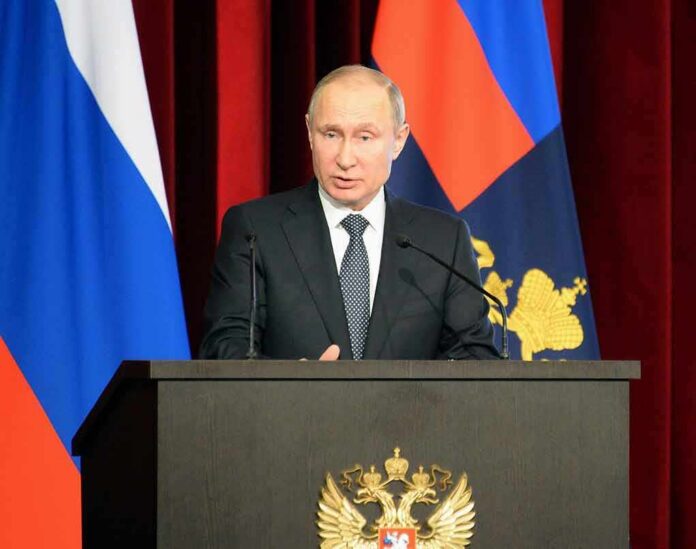
Putin’s February 24, 2022 address framed the war as more than a border fight. He vowed to “demilitarise and denazify Ukraine” and to bring alleged offenders “to trial,” which implies changing who holds power and how the state runs. That rhetoric matched years of claims that Ukraine’s tilt toward the North Atlantic Treaty Organization threatened Russia’s security. Those statements set expectations for pressure well beyond the Donbas line and hinted at forcing neutrality on Kyiv.
On February 21, 2022, Putin also warned against the West’s “military foothold” in Ukraine, calling it unacceptable. He tied the invasion to stopping that trend, not just adjusting borders. This pairing of military and legal aims suggested an intent to reshape Ukraine’s choices. Even so, Moscow also said it did not plan to occupy Ukraine, creating a tension between stated restraint and the scale of its demands. That split fuels today’s argument over what Russia truly intended.
Early-Phase Operations Pointed At Kyiv And Rapid Regime Shock
Multiple assessments describe an opening plan aimed at a quick break of Ukraine’s leadership. Reporting and military briefs say Russia sought to seize Kyiv fast and remove the government, using airborne thrusts and rapid ground pushes to trigger collapse. That picture fits a “decapitation” approach rather than a slow, block-by-block siege. The effort stalled under stiff resistance and poor logistics. Still, the direction and tempo of those first moves support the view of a planned sprint toward political control.
This reconstruction rests on patterns analysts use when war plans stay secret. Observers infer goals from force posture, axes of advance, and target choices. Here, thrusts toward the capital, the Hostomel airfield bid, and early columns moving from the north support a fast-shock concept. The evidence is not a signed order, but the convergence of reputable studies gives that reading weight. That is why many outlets still frame the first phase as a failed push to topple Kyiv’s leadership.
Denial Of “Occupation” And The Ongoing Debate Over Intent
Putin publicly denied plans to occupy Ukraine. He said Russia would not impose outcomes by force, even as he laid out maximal demands for Ukraine’s security choices and internal “cleansing” aims. The British Broadcasting Corporation later summarized his declared goal as demilitarization and “denazification,” not occupation. That denial muddies a clean read of intent. It also gives space to arguments that Moscow sought coercion without full control of all territory.
Critics highlight the lighter initial force, saying it was too small to hold most of Ukraine and instead aimed to shock Kyiv into concessions. They also argue a failed airborne strike proves a coup de main attempt, not a plan to occupy 60 percent of the country. Even so, the scale of political aims in Putin’s speech, and the axes into Kyiv, make the “pressure only” reading hard to square with facts. The better takeaway is mixed: limited public claims, but broad practical goals.
Why This Matters For America: Strength, Clarity, And No Blank Checks
For the United States, this is about hard-nosed deterrence and fiscal sanity. A Kremlin that binds war aims to political control tends to double down when cornered. That is the risk behind talk of an “escalation trap.” Washington should deter wider war, keep Europe carrying real weight, and protect our own borders and economy first. Clear red lines, energy strength at home, and tight oversight of every dollar are common-sense steps that back peace through strength without writing endless checks.
Sources:
zerohedge.com, reuters.com, bbc.com, afpc.org, ppr.lse.ac.uk