
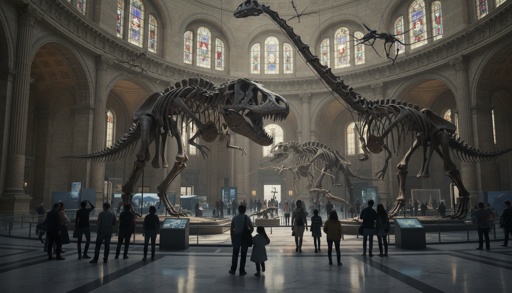
A triceratops skeleton that inspired generations of children in a Wyoming museum just sold privately and is now being auctioned to billionaires on Pharrell Williams’ luxury platform for up to $5.5 million, marking the latest battleground where the ultra-wealthy are outbidding scientists for access to prehistoric history.
When Museums Become Showrooms for Billionaire Shopping
The private owner of “Trey” exhibited the fossil in a Wyoming museum for decades before quietly selling it and shipping it to Singapore for exclusive viewings ahead of the Joopiter auction. This pattern transforms public institutions into inadvertent marketing channels for luxury assets. Pharrell Williams launched Joopiter to capitalize on what the platform’s Caitlin Donovan calls “culturally resonant” investments displacing traditional art. The celebrity appeal adds pop culture cachet to an already overheated market where recent sales have doubled or tripled conservative estimates, leaving auction houses scrambling to justify $4-6 million projections that routinely fetch $30-40 million.
The Record-Breaking Feeding Frenzy
Ken Griffin shattered auction records in 2024 when he paid $44.6 million for “Apex,” a Stegosaurus skeleton that dwarfed the previous 2020 record of $31.8 million for “Stan,” a T. rex purchased by Abu Dhabi’s Natural History Museum. Griffin’s purchase demonstrated how hedge fund titans view fossils as finite assets with unlimited upside, similar to masterpiece paintings or vintage Ferraris. Rally, a fractional investment platform, capitalized on this trend by launching a $12.5 million IPO for a Barosaurus skeleton still being excavated, currently 80-85% complete. The offering allows everyday investors to own shares in dinosaur bones, democratizing a market previously exclusive to celebrities like Nicolas Cage and Leonardo DiCaprio.
Scientists Watch Their Data Vanish Into Private Collections
Kristi Curry Rogers from Macalester College captures the academic frustration: museums are being systematically priced out while private collectors lock away specimens permanently. Field Museum paleontologists point out that over half of all known T. rex fossils now reside in private hands, creating irreversible gaps in scientific understanding of dinosaur growth patterns and behavioral evolution. Jared Hudson from the University of Pennsylvania warns that data becomes “lost forever” when collectors restrict access, even when specimens previously served public education for decades. The concern carries weight when museums operate on shoestring budgets while bidders with unlimited resources refuse to take no for an answer at auctions.
The Optimists Versus the Realists
Paleontologist Andre LuJan, who prepared “Trey” for auction, advocates for what he calls a “benevolent paradigm shift” where private owners eventually loan or donate fossils to museums. Griffin demonstrated this pattern by placing “Apex” on loan at the American Museum of Natural History after his record purchase. Rob Petrozzo from Rally argues that private sales rescue fossils from destruction and enable preservation that underfunded museums cannot afford. Auction houses Sotheby’s and Christie’s defend their role by emphasizing how commercial excavations unearth specimens that would otherwise erode into dust on remote ranch land.
The counterargument from academics like Thomas Carr rings hollow to market defenders but resonates with researchers who prioritize science over commodification. Patrick O’Connor from the Field Museum articulates the core tension: treating fossils as status symbols fundamentally conflicts with their value as irreplaceable scientific records. Amanda Hall adds that billionaire collectors seek prestige, not preservation. The debate hinges on whether temporary museum loans adequately substitute for permanent institutional ownership and unfettered research access. U.S. law exacerbates the conflict by allowing private landowners to sell discoveries without export restrictions, unlike most countries that classify fossils as national heritage.
A triceratops skeleton that stood in a Wyoming museum for decades will be auctioned off, a rare instance of a museum-exhibited dinosaur going to the auction block just as the market for the prehistoric giants has hit record highs. https://t.co/vQLL4rrAZu
— ABC News (@ABC) March 2, 2026
What Happens When Pop Culture Drives Paleontology
Pharrell’s Joopiter platform represents the collision of celebrity influence, investment mania, and scientific heritage. The auction scheduled for March 17-31, 2026 will test whether “Trey” follows “Apex” into the $40+ million stratosphere or settles closer to initial estimates. Hollywood portrayals of dinosaurs have spiked demand across Asia, the Middle East, and North America, transforming fossils into globally traded luxury goods. Auction frequency remains limited to every few years due to genuine scarcity, which only intensifies bidding wars when complete skeletons surface. The finite supply guarantees price appreciation for investors while simultaneously guaranteeing that museums will continue losing access to specimens they once displayed freely.
LuJan hopes “Trey” mirrors the “Apex” outcome with a museum loan, allowing the public to benefit from a billionaire’s investment. That optimism assumes buyers prioritize legacy over exclusivity, a generous interpretation of ultra-wealthy psychology. The harder truth is that current market dynamics reward private collectors while penalizing scientific institutions and the taxpayers who fund them. Fractional ownership through platforms like Rally offers a middle path, though it remains unclear whether shareholders will grant research access or simply chase returns. The transformation of museum dinosaurs into auction lots raises uncomfortable questions about whether America’s legal framework adequately protects scientific resources from becoming playthings for the超-rich who view prehistory as just another asset class to conquer.
Sources:
Dinosaur fossil sold for record $44.6 million: Why billionaires are racing to buy prehistoric giants
Webull News – Rally Fossil Investment Coverage