
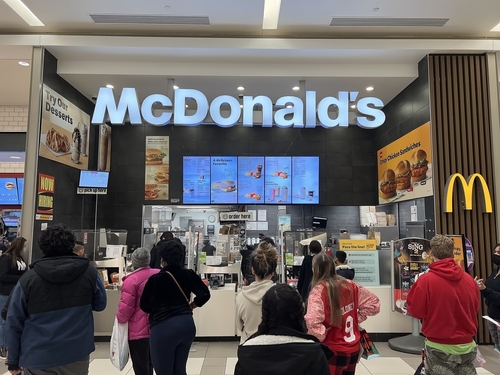
A McDonald’s in Minneapolis now works like a bank vault, and that single locked door tells you everything about what happens when public order quietly collapses.
Locked Doors At Lunchtime: What Changed At This McDonald’s
Staff at a Minneapolis McDonald’s now keep the dining room doors locked during business hours and personally decide who gets in, one customer at a time. Management did not turn the restaurant into a private club; they reacted to a years-long pattern of violence, harassment, and police activity that made a supposedly casual meal feel like a trip through a war zone. Patrons who pass the staff’s quick risk assessment can enter. Those who do not simply never make it past the glass.
Reports describe the site as operating with “doors locked and attended,” a phrase more often used for jewelry stores than burger chains. The goal is clear: filter out individuals who present “a risk” before they step onto the tile. That phrase covers everything from aggressive loiterers to people tied to prior disturbances. Customers see the symptom—a locked door—and only later realize it represents a running calculation about whether the surrounding streets feel safe enough to leave it open.
From Artsy Uptown To “Mogadishu” Comparisons
The restaurant sits in Minneapolis’ Uptown area, long marketed as an artsy, busy neighborhood full of nightlife and diverse crowds. Police once recorded around 400 incidents in a single year at a nearby McDonald’s there, a staggering figure for any retail corner. Commentators now talk about the area using loaded comparisons to “Mogadishu,” tying perceived decline to demographic shifts, including an influx of Somali immigrants and broader diversity changes. Those claims reflect opinion, not neutral data, but they resonate with frustrated locals.
Conservative voices frame the scene as the predictable result of leadership that downplays crime and prioritizes ideology over enforcement. They point to years of shootings, stabbings, and street disorder around fast-food and nightlife venues, arguing that city and state officials allowed standards to erode while lecturing residents about equity. From that vantage point, a locked McDonald’s door is not an overreaction; it is a last-ditch adaptation by a business tired of waiting for government to do its job.
When A Fast-Food Franchise Becomes Its Own Security State
This Minneapolis franchise joins a broader national trend where fast-food chains quietly add security layers that would have seemed absurd a decade ago—bouncers at the door, controlled entry, and extra cameras aimed more at “youth” mobs than at shoplifters. In the short term, such measures likely reduce disruptions inside the dining room, protect employees, and reassure regulars that someone is watching the door. In the long term, they normalize the idea that everyday transactions require screening.
From a common-sense, law-and-order perspective, that tradeoff looks backwards. Private businesses now shoulder the consequences of policy choices that weakened deterrence and blurred the line between compassion and permissiveness. Small decisions not to prosecute, not to hold repeat offenders, or not to back active policing accumulate until a restaurant has to act as its own checkpoint. The people who pay for that experiment are workers locking doors and customers wondering whether they just walked into lunch or into a fortress.
The Political Fault Lines Behind A Locked Door
Governor Tim Walz and other Minnesota leaders appear frequently in commentary about this story, often as symbols of what critics call a “collapse of order” in the state. Commentators argue that lenient criminal-justice approaches, combined with refusal to confront hard truths about problem hotspots, produced exactly this atmosphere of danger around once-normal venues. They see a straight line from progressive governance to boarded-up storefronts and guarded fast-food counters.
Supporters of tougher enforcement argue that a functional city does not force franchise managers to decide who looks like a “risk” on the sidewalk. Their position aligns with traditional conservative priorities: clear rules, firm policing, consequences for violent behavior, and equal protection for families who just want a safe place to eat. When those basics fail, informal triage takes over—doors lock, staff improvise, and trust in institutions drains away one late-night shift at a time.
What This Means For Everyday Americans
The locked-door McDonald’s sends a blunt message to anyone paying attention: urban decay no longer lives only in statistics or political speeches; it shows up in the most ordinary rituals, like grabbing fries with your kids. Customers lose spontaneity and convenience. Employees gain some safety but inherit the burden of gatekeeping strangers. Nearby residents see their neighborhood branded as “crime-ridden,” whether they contributed to the problem or not.
Similar measures will likely spread as more chains quietly choose self-preservation over blind optimism. Unless public officials restore consistent enforcement and support for police, ordinary businesses will continue turning themselves into mini security zones. For many Americans, the day their local McDonald’s locks the door at noon may be the moment they finally believe the headlines about crime, governance, and the real cost of letting order slip.
Sources:
McDonald’s locks doors to keep out individuals who present ‘a risk’ in crime-ridden Minneapolis area
Minneapolis McDonald’s will now have doors locked and attended during business hours
I suppose a reporter will sit there and count how many people in various demographic group out of all total people were allowed in. Surely racism is at the core of this.
Why is this a surprise to anybody? Tim Walz, Tampon Tim as Govenor, and Jacob Frey as Mayor, what could possibly go wrong. Actually, the same politics in California exist in Minneapolis, and I will bet the same Pathetic Sociopaths who elected Walz/Frey, will vote for them again, the same as the Califoria Losers elected NewScum, twice, and allowed him to remain in office after a major recall.