
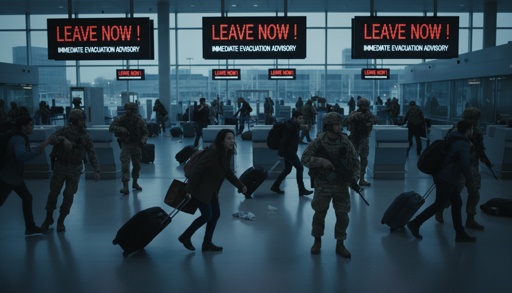
When the State Department uses the words “DEPART NOW,” it’s not travel advice—it’s a countdown.
“Depart Now” Signals a Narrowing Escape Window
Marco Rubio’s March 3 directive told Americans to get out of a long list of places—Bahrain, Egypt, Iran, Iraq, Israel, West Bank/Gaza, Jordan, Kuwait, Lebanon, Oman, Qatar, Saudi Arabia, Syria, the UAE, and Yemen—because serious safety risks had spiked. The key detail wasn’t the list; it was the verb. “Depart” implies you still can. “Now” implies that assumption may expire quickly.
Rubio’s message leaned hard on practical steps: leave via commercial transportation while it still runs, enroll in STEP for updates, and expect conditions to change with little warning. That approach fits the uncomfortable reality of fast-moving regional conflict: governments can advise, but they cannot conjure open air corridors. For Americans who hear “we’re monitoring the situation,” this was the upgraded version: “Time is the enemy.”
Operation Epic Fury and Iran’s Answer: Fast Escalation, Wider Targeting
The timeline matters because it explains why the State Department’s tone shifted. A worldwide caution came Feb. 28 after U.S. combat operations began, warning about disruptions and closures. On March 1, the U.S. launched Operation Epic Fury, striking Iranian military nodes such as command-and-control, air defenses, and missile or drone sites. Iran’s retaliation soon spilled into the Gulf, including attacks affecting the UAE and other cities—exactly the kind of expansion that punishes hesitation.
Shelter-in-place orders rolled out across U.S. missions in multiple countries, a blunt sign that the threat wasn’t theoretical. When embassies tell Americans to stay inside, they’re reacting to credible risks—missiles, drones, unrest, or all of it at once. For travelers, that changes the calculus overnight: you can’t “play it by ear” if roads clog, airports shut, or your local area flips from normal to restricted movement in hours.
Embassy Warnings Reveal the Hard Part: Limited Exit Options
Rubio’s guidance emphasized commercial departures for a reason: the United States had not announced mass evacuations, and some posts explicitly described evacuation options as very limited. That gap between public expectation and logistical reality drives much of the anger that surfaces in moments like this. Americans understandably want an “airlift plan,” but airlifts require airspace access, staging bases, secure routes, and time—four things that can vanish once missiles fly.
Airspace closures and travel disruptions function like a slow-motion trap. Flights get canceled, insurance and carrier policies change, and airlines avoid risk zones. Even if planes still fly, seats disappear fast, prices spike, and families debate whether to split up to grab the last available routing. The State Department’s 24/7 task force helps with information and emergency coordination, but it cannot guarantee that a ticket exists tomorrow simply because it existed today.
Riyadh’s Drone Strike: A Reminder That “Allies” Still Get Hit
The March 2 drone strike that hit the Saudi embassy compound in Riyadh—reported as minor damage with no injuries—carried a larger message than the physical impact. Diplomatic facilities operate under heightened security, yet drones still reached a sensitive site. That punctures the comforting belief that conflict stays confined to front lines. Modern retaliation favors reach over conquest: drones and missiles can target symbols, logistics, and energy hubs without needing armies on the ground.
For Americans living and working in Gulf states, that reality changes daily routines. The danger isn’t only direct attack; it’s the secondary shock: tightened security, closed roads, curfews, and sudden restrictions around critical infrastructure. The mention of places like Dhahran in broader warnings highlights what everyone in energy markets already knows: threats near oil corridors can ripple into prices, supply fears, and political pressure—fast.
Politics at Home: Strength, Strategy, and the Evacuation Question
President Trump framed continued bombing as necessary for peace, and allies such as Israel’s prime minister spoke in sweeping terms about quick outcomes and even regime change. Democrats criticized the administration’s planning and strategy, arguing the U.S. walked into escalation without a workable endgame. Common sense says both things can be true: decisive force can deter, and bad planning can still get Americans stranded. The test isn’t the slogan; it’s whether citizens have realistic exit paths.
American conservative values put citizen protection and governmental competence at the center. Advising Americans to self-depart on commercial flights is not cowardice; it can be the safest option when a formal evacuation would create a larger target or false hope. The competence question comes down to preparation: early, clear warnings; honest language about “limited options”; and rapid updates that don’t sugarcoat risk. “Depart now” is at least honest.
State Department Issues “DEPART NOW” Alert for Americans Across Middle East as War Spillover Hits US Interests https://t.co/5TWvfw7ldY
— The Gateway Pundit (@gatewaypundit) March 3, 2026
Americans in the region face a brutally simple decision tree: leave while routes exist, or gamble that tomorrow looks like today. The State Department’s phrasing suggests officials believe the window is open but narrowing, with violence spreading and diplomatic posts already operating under emergency posture. In crises like this, waiting for perfect certainty usually means missing the last ordinary flight—and replacing it with an extraordinary problem.
Sources:
americans-more-than-dozen-middle-east-nations-urged-flee
us-embassies-middle-east-iran-00808416
Worldwide Caution – Travel – State.gov
security-alert-exercise-increased-caution-march-2-2026
security-alert-iran-security-alert-shelter-in-place-and-departure-options-march-2-2026