

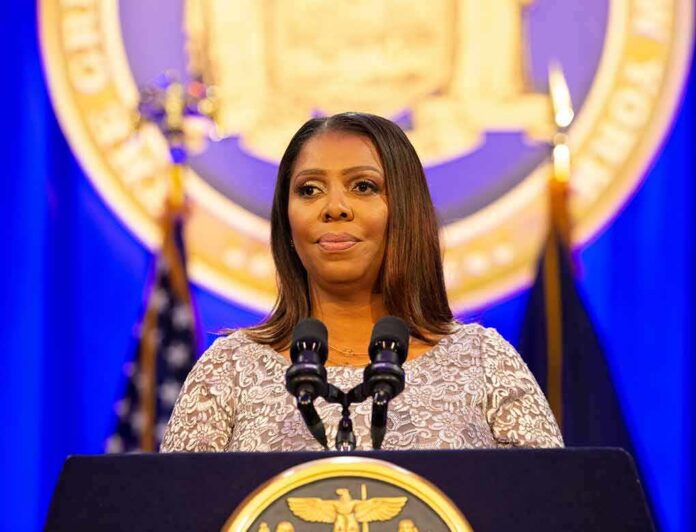
New reporting says donors tied to three troubled New York City shelter operators gave over $56,000 to Attorney General Letitia James as her office took no enforcement action against them since 2019.
Story Highlights
- Report links $56,000 in donations to Attorney General Letitia James with a lack of enforcement against three shelter operators.
- Named donors include a Samaritan Daytop Village board member and a lobbying firm, plus James’s longtime strategist and his spouse tied to Acacia Network.
- City and federal authorities previously scrutinized the operators; New York City cut ties with CORE and sued over executive pay.
- Critics say James “refused” to act; her office’s public records page does not show a clear response to these claims.
What the report alleges about donations and non-enforcement
LifeZette reports that Samaritan Daytop Village, Acacia Network Housing, and CORE Services Group have faced no enforcement action from the New York Attorney General’s office since 2019, while people connected to them gave more than $56,000 to Letitia James’s campaigns. The report names Samaritan board member Vito F. Pitta, who gave $6,000, and his firm, Pitta LP, which gave $22,500. It also names James’s longtime strategist, Luis Miranda Jr., a lobbyist for Acacia, and his spouse, with $25,898 combined.
The report says these operators drew attention from other watchdogs. It cites actions by the New York State Comptroller, the state Inspector General, the New York City Department of Investigation, and federal authorities. It adds that a 2024 city Department of Investigation review of 51 providers flagged nepotism, a lack of competitive bidding, and high executive pay, and included Acacia and CORE in its scope. These points frame the donations as noteworthy in light of ongoing oversight concerns.
Concrete actions taken against CORE by other authorities
The record for CORE includes firm steps by New York City and federal agents. New York City ended its relationship with CORE in November 2021, and federal agents raided CORE’s Brooklyn headquarters in December 2021, according to the reporting. The city also sued to recover $2.3 million in alleged excessive executive salaries from CORE leadership. These events show that serious issues were raised elsewhere even as critics say the attorney general’s office did not bring an enforcement case against the same operator.
The report also places claims about James’s office in a broader context. It notes prior investigations and reviews by several agencies, which can split responsibility and make it unclear who must act first. The Office of the New York State Attorney General regulates nonprofits and says it protects donors and ensures proper use of charitable funds, which includes oversight of charities operating shelters. That stated mission helps explain why critics expected action by the state attorney general.
What critics say and what the public record shows
The New York Post has highlighted attacks from Republican attorney general hopeful Saritha Komatireddy, who says James ignored fraud in the shelter system. The Post’s reporting also carried a response from a James spokesperson saying she protected funding and supports dignity for all New Yorkers, while attacking President Trump’s proposed funding cuts; that response did not address the donation-linked non-enforcement allegation in detail. The attorney general’s public site includes a search tool but no direct public memo answering these specific claims.
Nassau County Exec & NY Gov candidate Bruce Blakeman faces intensifying controversies: State Democrats file matching-funds complaint over $860K in ineligible donations, backlash grows over his AI campaign ads, and high-profile debate clashes erupt with NYC leaders.
— Casey Jones (@CaseyJonesNYC) October 29, 2026
Separately, James’s office has pursued some nonprofit fraud cases, including a 2021 plea involving a Bronx nonprofit tied to a homeless shelter, which ended with restitution and dissolution. That case shows the office can and does prosecute shelter-related misconduct. Still, the current criticism focuses on three named operators and the reported donations during the same years. Academic and policy research have found that large donations can raise corruption risks in public contracting, which explains public concern when donors connect to government-funded providers.
Sources:
nypost.com, lifezette.com, hotsheet.com, ag.ny.gov, ideas.repec.org