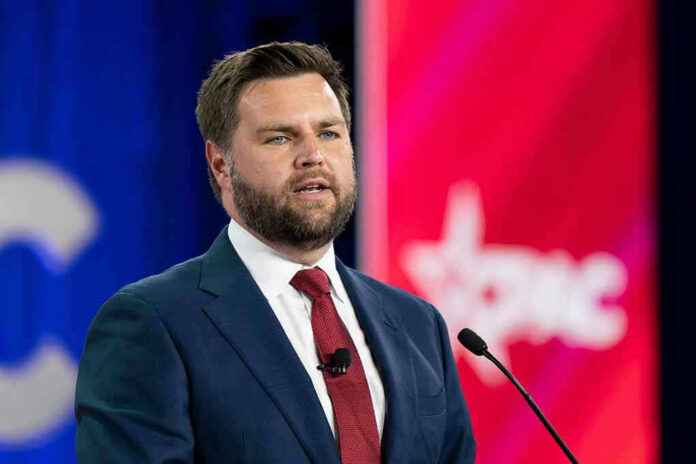
Vice President J.D. Vance says America has paid more than its fair share for Ukraine’s war, and he wants a real peace deal instead of endless checks to Kyiv.
Quick Take
- Vance voted against a nearly $61 billion Ukraine aid package in April 2024.
- At the 2025 Munich Security Conference, he called for peace negotiated “from a position of strength.”
- His plan keeps Ukraine and European allies at the table, not sidelined.
- Sanctions and other pressure on Russia stay on the table if talks collapse.
A Clear Break From Blank-Check Policy
Vance did not come to this position overnight. In May 2024, he said plainly that funding “an effectively never-ending war in Ukraine” was not in America’s interest. He argued the United States had already “done more than our fair share”. That same spring, he voted against a foreign-aid package carrying nearly $61 billion for Ukraine, telling colleagues Russia’s threat to global stability had been overstated.
That record matters now that Vance helps run foreign policy as vice president. He is not a newcomer improvising a position. He built a public paper trail for two years before he ever stood on a world stage representing the United States at the Munich Security Conference.
Munich Speech Lays Out the Strategy
At Munich in February 2025, Vance said the administration believed it could reach “a reasonable settlement between Russia and Ukraine”. He framed the path forward around negotiating “from a position of strength,” rejecting the idea that peace means Ukraine simply surrenders ground to end the fighting. His written remarks also insisted that “European and Ukrainians must play an active part in the negotiations,” arguing that only a united front can produce “a stable and long-lasting peace”.
That last point separates Vance’s approach from a simple withdrawal plan. He is not arguing for cutting Ukraine loose and walking away. He is arguing that Washington should stop writing blank checks while still backing a settlement that includes Kyiv and its European neighbors at the negotiating table.
Leverage Stays On The Table
Vance’s public position leaves real pressure tools in reserve. Reporting at the time of his Munich remarks described economic tools, including sanctions, as available leverage against Moscow. It also noted that military options, including a possible U.S. peacekeeping role, had not been ruled out if Russia negotiated in bad faith. That combination lets Vance argue for fewer blank-check dollars while keeping real consequences on the table for Vladimir Putin.
By December 2025, Vance was candid about the odds. He said he had no confidence Ukraine and Russia would reach a peace deal, a blunt admission that talks remain difficult and unresolved. One honest caveat belongs here: a negotiating stance is not the same as a signed deal, and nothing in the public record claims otherwise.
Burden-Sharing Push Targets Europe
Vance has repeatedly tied his Ukraine position to a bigger demand: Europe needs to carry more of its own defense weight. Research on burden-sharing in the war found that geography, not ideology, best predicts which nations keep funding Ukraine over time, with countries closer to Russia staying more committed than distant ones. That pattern backs up Vance’s argument that wealthy European nations, sitting right next to the conflict, should shoulder more of the cost than American taxpayers thousands of miles away.
At Munich, Vance also redirected part of his speech toward Europe’s internal politics, saying the threat he worried about most was not Russia or China but democratic backsliding at home. Critics could call that a distraction from the war itself. Supporters see it as Vance refusing to let European leaders dodge their own governing failures while asking Americans to keep footing Ukraine’s bill.
What Comes Next
Vance’s stated goal remains consistent: end the war through negotiation, keep Ukraine and Europe involved, and stop treating endless American funding as the only option. The details of enforcement, territory, and timing are still being worked out in real time. For a conservative base tired of open-ended foreign spending, Vance’s message is simple: American strength should buy peace, not a permanent subscription to someone else’s war.
Sources:
nato.int, transcripts.cnn.com, abcnews.com, securityconference.org, ro.usembassy.gov, politico.com, css.ethz.ch