

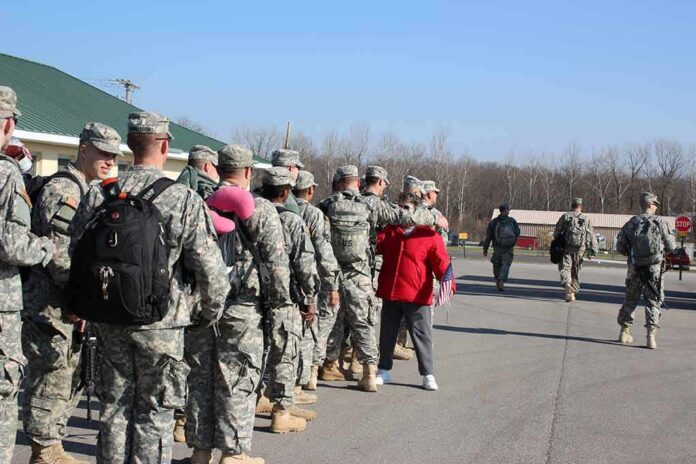
The most important thing to understand about Iranian military spokesman Abolfazl Shekarchi’s warnings that “no place” is safe for American troops is not the specific threat itself — it is the strategic logic behind broadcasting it publicly, repeatedly, and in increasingly graphic terms. This is deterrence rhetoric with a long pedigree, and its real power lies less in demonstrated capability than in the costly precautions it forces adversaries to take.
Key Points
- Shekarchi’s warnings — extending from battlefields to hotels, resorts, and tourist destinations — are extensively documented across dozens of outlets, with direct, consistent quotations attributed to him by name.
- The threats fit a decades-long Iranian pattern of psychological and asymmetric warfare rather than a single new escalation.
- U.S. official responses emphasize self-defense, capability degradation, and force protection rather than directly rebutting the specific quoted claims.
- Real-world U.S. actions — troop withdrawals, remote-work arrangements, hardened lodging — indicate the threats were treated as operationally credible, not dismissed as bluster.
- The dispute that matters going forward is not whether Iran said this, but whether rhetoric of universal vulnerability translates into sustained operational reach.
What Shekarchi Actually Said, and Why the Wording Matters
Shekarchi’s core claim, reported by TASS and sourced to Iran’s ISNA news agency, is unambiguous: U.S. and Israeli personnel “involved in the aggression against Iran will never be safe again.” What distinguishes this iteration from routine wartime bluster is its deliberate expansion of the target category. On Iranian state television he argued that any hotel housing American forces “becomes American” territory in Iran’s targeting logic — “when we respond, naturally, we have to strike wherever they are,” as reported by the Times of Israel. Iran International separately quoted him extending the threat to “recreational and tourist locations around the world,” a formulation repeated nearly verbatim across Kurdistan24, Ynet, and the Economic Times.
This is not incidental phrasing. Military spokesmen speaking on state media operate under tight message discipline; the repetition of “hotel,” “resort,” and “tourist destination” across multiple broadcasts signals a calculated attempt to erase the psychological distinction between hardened military installations and the civilian-adjacent spaces where personnel actually live, eat, and travel when off base. That distinction has mattered enormously to force-protection doctrine since the 1983 Beirut barracks bombing; collapsing it is precisely the point.
A Threat Vocabulary Four Decades in the Making
None of this emerged from nowhere. The American Jewish Committee traces “the Iranian regime’s war on America” back to the 1979 revolution, documenting a sustained campaign against U.S. troops, diplomats, and citizens that long predates any single spokesman’s press conference. The Foundation for Defense of Democracies has cataloged Iranian and Iranian-backed attacks on Americans stretching from the Beirut bombing through repeated 2025 strikes on U.S. bases in Syria and Iraq. Brookings has noted that Supreme Leader-linked figures have explicitly threatened that the region will “no longer serve as shields for American bases,” language that predates the current spokesman’s remarks by years. The Middle East Institute frames this as a consistent strategic objective — ousting the U.S. military from the region — pursued through proxies as much as through direct statements.
Seen against this history, Shekarchi’s warnings read less as a novel escalation than as the latest verse in a well-rehearsed script. What has changed is the operational backdrop: waves of strikes on U.S.-linked sites in Kuwait, Bahrain, Jordan, and Iraq have given the rhetoric a body count to point to, however contested the attribution and scale of each incident remains.
Where the U.S. Response Actually Disagrees — and Where It Doesn’t
The American institutional response does not, on close inspection, dispute that Shekarchi said what he said. CENTCOM’s public releases describe specific, incident-based strikes — for instance, retaliation after an Apache helicopter was downed — framing the conflict as a sequence of measured responses rather than conceding an unconstrained Iranian reach. The State Department has similarly characterized U.S. actions as collective self-defense, emphasizing that forces are “positioned and prepared” rather than simply exposed. This is a difference in framing, not a factual rebuttal: nowhere in the public record does a U.S. official directly refute the quoted claim that hotels housing American personnel could become legitimate targets.
What is more telling is what the United States actually did. Reuters reported that Washington withdrew some personnel from regional bases as a precaution after Iranian retaliation warnings — a decision that treats the threat as credible enough to act on, not as noise to be ignored. The New York Times went further, reporting that Iran’s attacks forced American troops into remote-work arrangements, a striking admission that conventional basing had become untenable under threat conditions. NBC’s Pentagon coverage of a missile strike on a U.S. base in Jordan, with confirmed injuries, reinforced that the danger was not merely theoretical. None of this proves Iran can strike “anywhere,” but it confirms that U.S. force planners were not treating the rhetoric as empty.
The Honest Middle Ground: Intent Is Proven, Reach Is Contested
The fair reading of the evidence splits cleanly along a line that matters more than partisan sympathy. Iran’s intent to threaten broad, civilian-adjacent target sets is exhaustively documented — across TASS, Iran International, Kurdistan24, Mehr News, and Al-Manar, the quotations are consistent, attributed by name, and repeated over months, not walked back. What remains genuinely contested is operational reach: whether Iranian missiles, drones, and intelligence networks can actually locate and strike dispersed personnel in hotels and office buildings with the reliability the rhetoric implies, as opposed to hitting fixed, known installations that were always vulnerable to attack. The Institute for the Study of War has characterized Iran’s approach as “calibrated force” designed to extract concessions without triggering full-scale U.S. retaliation — a description that suggests strategic signaling as much as demonstrated capability.
U.S. officials, for their part, have emphasized their own capacity to “degrade” Iranian military infrastructure — air defenses, radar sites, missile production — through sustained strikes described by PBS and CBS, a rebuttal aimed at capability rather than intent. Neither side has produced, in the public record, a forensic accounting that definitively settles how far Iran’s actual reach extends beyond its stated ambitions.
Why This Pattern Endures and What It Changes
The practical consequence of this rhetoric is measurable regardless of how the capability debate resolves. Travel advisories tighten. Lodging policies for deployed personnel grow more restrictive and more expensive. Interceptor stocks like THAAD and Patriot systems, which take months to replenish, get drawn down responding to both real and threatened attacks. Diplomatic bandwidth gets consumed managing perception as much as managing actual risk. Whether or not every hotel Shekarchi named is truly within Iran’s reach, the warning itself reshapes American military posture, allied basing agreements, and civilian travel calculus across an entire region — which is, ultimately, the objective such statements are designed to achieve.
🇺🇸⚔️🇮🇷 – Trump has issued a new, explicit threat against Iranian civilian infrastructure.
On Truth Social Tuesday (July 22), he wrote: "From this point forward, any time the Islamic Republic of Iran shoots at a ship in the Strait of Hormuz — whether it be by Missile, Rocket,… pic.twitter.com/tMUgK71FEx
— 🔥🗞The Informant (@theinformant_x) July 22, 2026
Reading the Next Warning
Future iterations of this same threat — and there will be future iterations — should be read through this same dual lens: as a well-documented statement of Iranian intent, consistent with four decades of doctrine, and as an unresolved question of operational reach that no public U.S. rebuttal has definitively closed. Readers who treat the rhetoric as pure bluff ignore the real force-posture changes it has already produced; readers who treat it as proven fact ignore that U.S. officials continue to describe the fight in terms of discrete, manageable incidents rather than an uncontainable threat. The truth sits, uncomfortably, between those two poles.
🟦 EVENING RECAP — July 21, 2026
⭕️BREAKING
• Tehran, Iran: A loud explosion was reported in District 8 of the capital. The cause remains unclear.
• Kuwait: Iranian missiles and drones are targeting the country again. Direct missile impacts have been reported, while Kuwaiti… pic.twitter.com/lZIdCi6rfb
— ZIONS OF ISRAEL (@Israeli_Sniper) July 21, 2026
Sources:
pjmedia.com, tass.com, youtube.com, iranintl.com, kurdistan24.net, islamtimes.com, balkanweb.com, komonews.com, en-archive.almanar.com.lb, en.mehrnews.com, ynetnews.com