
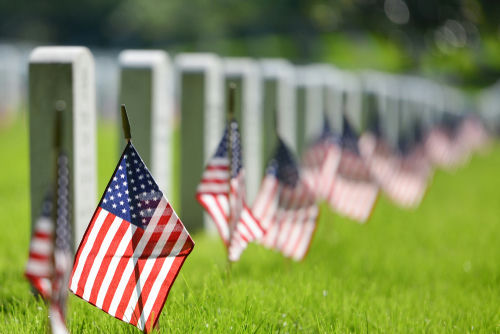
A little-known Arlington grave holding the irradiated body of a Cold War soldier quietly reminds Americans what happens when Washington chases dangerous technology without fully protecting its own troops.
Story Snapshot
- Arlington National Cemetery confirms it holds a single radioactive grave tied to America’s first fatal nuclear accident.
- Army Specialist Richard Leroy McKinley died after the 1961 SL‑1 reactor disaster and was buried under extreme containment measures.
- Official files still warn his body must never be moved without approval from federal nuclear authorities.
- The case exposes how ordinary warriors sometimes pay the highest price for elite experiments and policy failures.
The Only Radioactive Grave in America’s Most Sacred Cemetery
Arlington National Cemetery’s own Cold War walking tour guide states plainly that the white marble headstone of Specialist 4 Richard Leroy McKinley “marks Arlington National Cemetery’s only radioactive grave” and tells the story of America’s first fatal nuclear accident.[3] The guide identifies McKinley by name, rank, birth and death dates, and grave location in Section 31, making clear this is not legend but an officially recognized and documented case within the cemetery’s educational materials.[3]
The same Arlington document explains that McKinley’s grave looks like the others at first glance, but it is permanently linked to the SL‑1 nuclear reactor accident in Idaho, described as “America’s first fatal nuclear accident.”[3] Tour directions give step‑by‑step instructions from the Welcome Center to Section 31 so visitors can find the site, underlining that Arlington sees his story as part of the broader Cold War sacrifice, even though most Americans have never heard of either the reactor or the man who died working on it.[3]
Check this out. A radioactive grave site. pic.twitter.com/1Atfu5BUhz
— Steve 🇺🇸 (@SteveLovesAmmo) March 28, 2026
The SL‑1 Reactor Disaster and a Soldier’s Final Moments
According to Arlington’s account, McKinley was one of three men found after the SL‑1 incident: Army Specialist John Arthur Byrnes, Navy Seabee Richard Carlton Legg, and McKinley himself, discovered amid dangerously high radiation levels at the Idaho reactor facility.[3] Byrnes and Legg were already dead when rescuers arrived, while McKinley briefly survived the initial blast but died shortly after being placed in an ambulance, making all three casualties of that single catastrophic control rod event.[3]
Military history coverage later echoed and expanded those details, noting that on January 3, 1961, operators at the United States Army’s Stationary Low‑Power Reactor One returned from a holiday break when a control rod was pulled too far, causing the reactor to go “supercritical” in milliseconds and leading to an explosion that killed the three servicemen.[2] These accounts emphasize that the SL‑1 disaster remains the only fatal nuclear accident on United States soil involving the Army, reminding readers how one operational mistake in a government experiment can permanently alter several families’ lives.[2]
A Funeral at a Distance and a Grave That Must Never Be Disturbed
Because McKinley’s body was saturated with long‑lasting radioactive material, Arlington records describe a funeral unlike any other in the cemetery’s history.[3] On January 25, 1961, just over three weeks after the accident, his family was allowed to attend only from about twenty feet away as an eight‑minute service concluded with his casket lowered quickly into the ground, minimizing exposure risk to those paying their respects.[3]
Arlington’s educational file records that McKinley was buried in a double lead‑lined casket, encased in concrete, surrounded by a metal vault, and placed in a grave ten feet deep with an extra foot of concrete poured on top.[3] Both Arlington and later military histories note that his permanent file carries a stark warning: “Victim of nuclear accident. Body is contaminated with long-life radioactive isotopes. Under no circumstance will the body be removed from this location without prior approval of the Atomic Energy Commission in consultation with this headquarters.”[2][3]
Cold War Sacrifice, Government Experiments, and Conservative Concerns
Arlington’s Cold War tour explicitly labels McKinley “one of three victims of the United States’ first nuclear accident — a casualty of the Cold War as much as those who died in the battles of the era,” placing his death alongside more visible sacrifices in Korea, Vietnam, and Europe.[3] The narrative highlights that he had previously served in the Korean War, then was reassigned to nuclear power work, showing how an ordinary enlisted man carried the burden of risky federal experimentation far from any battlefield.[3][5]
Secondary accounts underscore that while Byrnes and Legg were buried back home, McKinley’s wife requested Arlington because of his Korean War service, and because his contamination required extraordinary precautions.[2][3] For readers concerned with limited government and respect for the rank‑and‑file soldier, McKinley’s story offers a sober reminder: when Washington pushes the edge of technology without full transparency, it is often regular service members whose bodies, graves, and families bear the long‑term consequences.[1][2]
Sources:
[1] Web – America
[2] Web – [PDF] COLD WAR – Education – Arlington National Cemetery
[3] Web – This E-4’s grave is the most dangerous gravesite in the world
[5] Web – SP4 Richard Leroy McKinley (1933-1961) – Find a Grave Memorial